
Overview
Pulse oximetry is a non-invasive, painless method of monitoring a person’s oxygen saturation and pulse rate.
The pulse oximeter is the device used to measure this. It became widespread in the 1980s and is now a standard tool in hospitals, clinics, EMS, and even home care.
It is especially important in respiratory, cardiac, and sleep medicine because oxygen delivery is critical for tissue survival.
What is Pulse Oximetry?
Pulse oximetry is a photometric method of estimating the percentage of hemoglobin in arterial blood that is saturated with oxygen, called SpO₂, and measuring pulse rate.
Epidemiology
-
Hypoxemia is common in respiratory diseases: COPD, asthma, pneumonia, COVID-19.
-
Obstructive Sleep Apnoea (OSA) affects ∼9-24% of adults and 1-4% of children globally.
-
Pulse oximetry is now used for screening in primary care, wards, ICU, and home monitoring because of its low cost and ease of use.
-
In children, adenotonsillar hypertrophy is the leading cause of OSA, ∼2-3% of children 2-8 years.
Pathophysiological Bases Of Pulse Oximetry
The principle is based on 2 things:
1. Oxyhemoglobin vs Deoxyhemoglobin light absorption:
- O₂Hb absorbs more infrared light ∼940nm
- HHb absorbs more red light ∼660nm
2. Pulsatile nature of arterial blood: The device isolates the AC component from arterial pulsation to calculate saturation, ignoring venous blood, skin, bone.
Formula: SpO₂ = {O₂Hb} ÷ {O₂Hb + HHb} x 100%
It assumes normal hemoglobin and no dyshemoglobins.
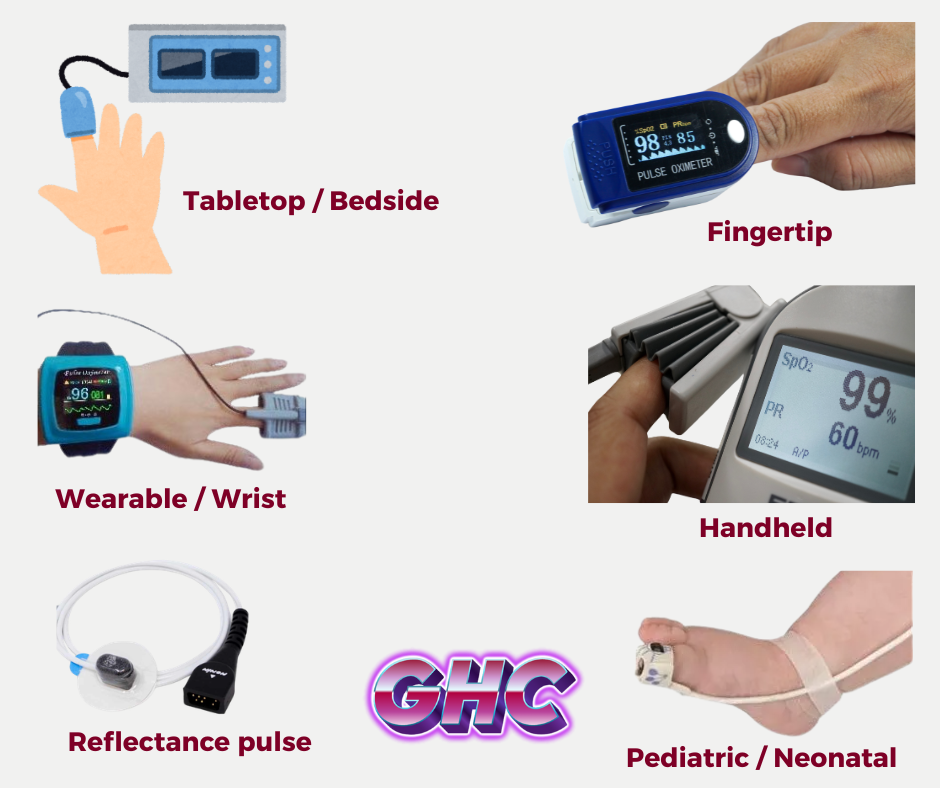
Types of Pulse Oximeters
-
Fingertip/Handheld pulse oximeter
Most common, portable, for spot checks
-
Tabletop/Bedside pulse oximeter
ICU, OR. Has waveform, alarms, trend data
-
Wearable / Wrist pulse oximeter
For ambulatory and sleep monitoring
-
Pediatric / Neonatal probes
Wrap-around sensors for small fingers, toes, ears
-
Reflectance pulse oximeter
Forehead, earlobe. Used when perfusion is poor
-
Multi-wavelength / CO-oximetry
Hospital grade, can detect COHb, MetHb
What Does Pulse Oximeter Measure?
1. SpO₂: Peripheral oxygen saturation %
2. Pulse rate: Beats per minute.
3. Plethysmographic waveform: Quality of perfusion
Some advanced models also estimate: Perfusion Index, Respiratory rate
Normal And Abnormal Pulse Oximeter Readings
| Reading | Interpretation |
|---|---|
|
95% – 100% |
Normal for healthy adults and children at sea level |
|
91% – 94% |
Mild hypoxemia. Monitor closely |
|
86% – 90% |
Moderate hypoxemia. May need oxygen |
|
≤ 85% |
Severe hypoxemia. Urgent intervention needed |
|
≤ 90% |
Generally considered abnormal and trigger for supplemental O₂ in most guidelines |
Note: Target may be 88 – 92% in COPD patients
Reliability Of Pulse Oximeter Readings
Factors that reduce accuracy:
-
Poor perfusion: shock, hypothermia, vasoconstriction
-
Motion artifact
-
Nail polish, artificial nails, skin pigmentation
-
Dyshemoglobins: CO poisoning, Methemoglobinemia
-
Ambient light interference
-
Low battery/signal
Accuracy: Usually ± 2% when SpO₂ > 70%. Less accurate < 80%
Response To Pulse Oximeter Readings
-
1. <90%:
Assess airway, breathing, give supplemental O₂, escalate care
-
2. Desaturation with exertion:
Consider pulmonary or cardiac disease
-
3. Intermittent desaturations during sleep:
Suspect OSA
-
4. Trend monitoring:
More useful than single reading. Look for patterns
-
5. False alarms:
Check probe placement, perfusion, motion first
Use Of Pulse Oximetry In Monitoring Obstructive Sleep Apnoea (OSA) In Adults - Children
Pulse oximetry is used as overnight oximetry for OSA screening:
-
Adults:
Looks for cyclical desaturations ≥3-4% associated with apneas/hypopneas. Used in home sleep testing.
-
Children:
Used to detect nocturnal hypoxemia. Especially useful in adenotonsillar hypertrophy where OSA presents with snoring + desaturations.
It does NOT diagnose OSA alone but helps stratify risk.
Reliability Of Pulse Oximetry In Obstructive Sleep Apnoea
Strengths:
-
Cheap, easy, available for home use
-
Good at detecting moderate-severe OSA with significant desaturations
Limitations:
-
Cannot detect respiratory effort or arousals
-
May miss mild OSA or upper airway resistance syndrome with no desaturation
-
False negatives in patients who desaturate minimally
-
Cannot differentiate central vs obstructive apneas
Overall: High specificity, but moderate sensitivity for OSA.
Pulse Oximetry Vs Sleep Studies In Diagnosing Obstructive Sleep Apnoea
| Pulse Oximetry | Polysomnography (PSG) / Sleep Study | |
|---|---|---|
|
Measures |
SpO₂, Pulse only |
EEG, EOG, EMG, Airflow, Effort, SpO₂, Video |
|
Cost |
Low |
High |
|
Setting |
Home |
Lab / Attended |
|
Diagnosis |
Screening tool only |
Gold standard. Gives AHI |
|
Detects arousals |
No |
Yes |
|
Use |
Triage, monitoring |
Definitive diagnosis + titration |
Conclusion: Oximetry is good for screening, but PSG is needed for definitive diagnosis.
How Useful Is Pulse Oximetry In Managing Children With Obstructive Sleep Apnoea Due To Adenotonsillar Hypertrophy
Very useful for:
-
1. Screening:
Children with loud snoring + overnight desaturations are high risk and should be prioritized for adenotonsillectomy.
-
2. Severity assessment:
More frequent/severe desaturations correlate with worse OSA.
-
3. Post-op monitoring:
To ensure resolution of hypoxemia after surgery.
-
4. Home monitoring:
For children awaiting surgery or with residual OSA.
However, normal oximetry does NOT rule out OSA in children. Many have arousals without desaturation. So it’s an adjunct, not replacement for clinical assessment +/- PSG.
In Conclusion,
Pulse oximetry is a vital, non-invasive tool for assessing oxygenation and pulse. While simple and reliable, its accuracy depends on technique and patient factors.
In OSA, it serves as a valuable screening and monitoring tool in both adults and children, especially for adenotonsillar hypertrophy. However, it cannot replace full sleep studies for diagnosis.
Used correctly, pulse oximetry helps in early detection, monitoring, and timely intervention to prevent complications of hypoxaemia
Share Post On:
Recent Posts
Categories
Get in Touch
Read doctor-produced health and medical information written for you to make informed decisions about your health concerns.