
Laser In Modern Otorhinolaryngology (Orl) Practice
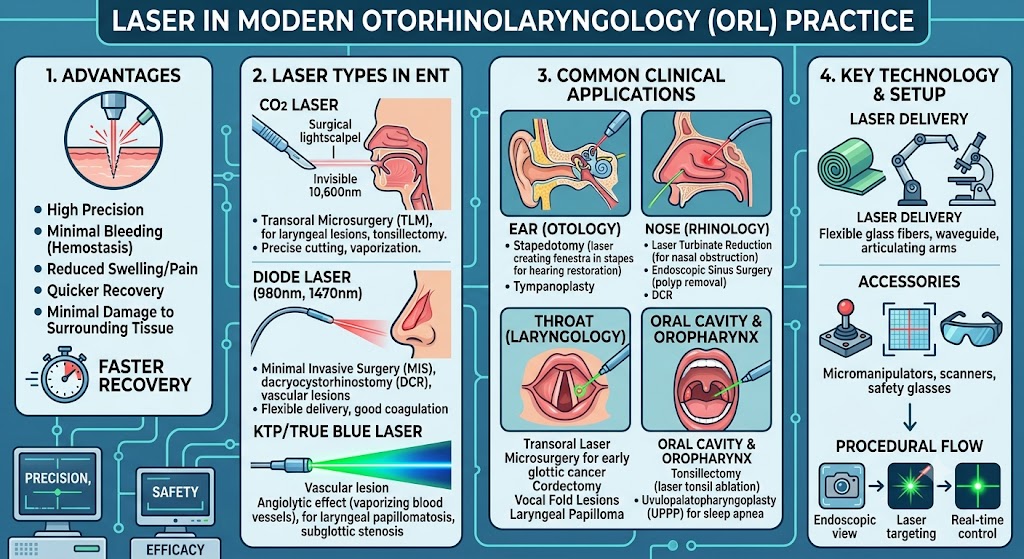
Overview
ORL deals with the ear, nose, throat, and head & neck — all areas that are narrow, collapsible, dark cavities with limited access.
Visualization is often obscured by:
- Secretions: mucus, pus, cerumen
- Bleeding: from friable mucosa or tumors
- Anatomy: narrow laryngeal inlet, sinuses, Eustachian tube, middle ear cleft
Traditional “cold steel” instruments struggle here because they require space, cause more bleeding, and have limited precision.
LASER was introduced to ORL in the 1970s to overcome these exact problems: it provides bloodless, precise cutting and coagulation in tight spaces under magnification.
What is LASER?
LASER = Light Amplification by Stimulated Emission of Radiation
It is a device that produces a highly focused, monochromatic, coherent beam of light.
In surgery, this light energy is converted to heat when it hits tissue, causing cutting, vaporization, or coagulation.
Principles involved in the use of LASER?
4 key tissue-laser interactions determine effect:
1. Photothermal: Light absorbed → heat → vaporization, coagulation, cutting. This is the main surgical principle.
2. Photochemical: Used in PDT for tumors
3. Photoablative: Ultra-short pulses break molecular bonds. Used in excimer lasers
4. Photomechanical: Shock waves for lithotripsy
Key factors:
-
Wavelength:
Determines depth of penetration and what chromophore absorbs it. E.g. Hemoglobin absorbs KTP, Water absorbs CO₂.
-
Power density:
W/cm². Determines cutting vs coagulation
-
Mode:
Continuous wave vs Pulsed. Pulsed = less thermal damage
-
Delivery system:
Microscope, fiber, waveguide, handheld
Common LASERs in ORL:
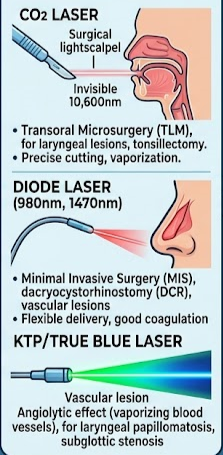
Figure 1
LASER Types in ENT (Ear, Nose & Throat) Clinic
| LASER | Wavelength | Target Chromophore | Main ORL Use |
|---|---|---|---|
|
CO₂ Laser |
10,600 nm |
Water Larynx, oral cavity, skin. |
Precise cutting |
|
KTP Laser |
532 nm |
Hemoglobin |
Vascular lesions, RRP, nasal polyps |
|
Diode Laser |
810 – 980 nm |
Hemoglobin, melanin |
Turbinate reduction, tonsils |
|
Nd:YAG |
1,064 nm |
Deep tissue |
Hemangiomas, tumor debulking |
|
Er:YAG |
2,940 nm |
Water |
Superficial skin, bone |
LASER vs Traditional "COLD STEEL" Surgery
| Cold Steel | Laser Surgery | |
|---|---|---|
|
Hemostasis |
Requires cautery, packing |
Simultaneous cutting + coagulation |
|
Precision |
Good, but limited by hand tremor |
Micron precision, especially with microscope |
|
Access |
Needs exposure, retractors can be used. |
Flexible fiber in narrow areas |
|
Tissue Damage |
More mechanical trauma, edema |
Minimal collateral damage if parameters correct |
|
Operative Time |
Longer for vascular areas |
Faster for vascular lesions |
|
Post-op pain |
More |
Less edema and pain |
|
Cost |
Low |
High equipment + training cost |
Epidemiology
Laser use in ORL has grown since the 1980s.
-
Laryngology:
∼70% of benign and early malignant laryngeal lesions in tertiary centers are now done with laser
-
Rhinology:
Diode/KTP laser turbinate reduction is common for allergic rhinitis
-
Oncology:
CO₂ laser is standard for T1/T2 glottic cancer and early oropharyngeal cancer in many centers
-
Pediatrics:
CO₂ / KTP laser is treatment of choice for Recurrent Respiratory Papillomatosis - RRP
Pathologies that require LASER
Broadly: Vascular lesions, papillomatous lesions, early malignancies, stenoses, and any lesion in a difficult-to-access area with high bleeding risk.
Use of LASER by ORL subspecialty
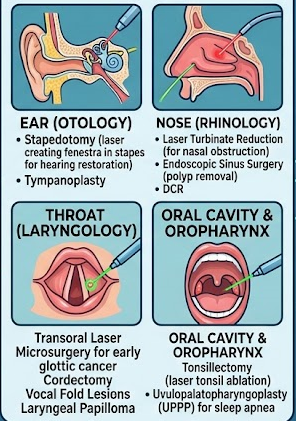
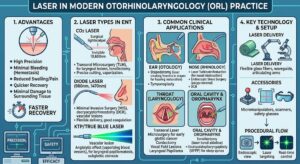
Figure 2
Common Clinical Applications
Rhinology
-
Turbinate reduction:
Diode, CO₂, Nd:YAG for inferior turbinate hypertrophy in allergic/vasomotor rhinitis
-
Nasal polyps:
KTP/Diode for debulking
-
Hereditary hemorrhagic telangiectasia:
KTP/Argon for nasal telangiectasia
-
Septal spur / cautery:
Diode for controlled turbinate cautery
-
Advantage:
Outpatient, minimal bleeding, no packing
Otolology
-
Stapedotomy:
Er:YAG or CO₂ laser to make fenestra in footplate. More precise than drill
-
Cholesteatoma:
CO₂ to vaporize residual matrix in difficult areas
-
Tympanic membrane perforation:
CO₂ laser myringoplasty
-
Limited use
Due to risk to inner ear. Requires very low power.
Head And Neck Surgery / Oncology
-
Transoral Laser Microsurgery - TLM:
CO₂ laser for T1-T2 cancers of larynx, oropharynx, hypopharynx
-
Tumor debulking:
Nd:YAG for palliation of obstructive airway tumors
-
Vascular malformations:
KTP/Diode/Nd:YAG for hemangiomas, venous malformations
-
Salivary duct stones:
Holmium laser sialendoscopy
Laryngology
This is where laser revolutionized practice.
Indications: Vocal cord nodules, polyps, cysts, papillomas, leukoplakia, T1a glottic cancer, laryngeal stenosis, webs.
| Cold Steel Microinstruments | CO₂ Laser | |
|---|---|---|
|
Precision |
Good, with cup forceps, scissors |
Superior, 0.1mm spot size |
|
Bleeding |
Often needs topical adrenaline |
Bloodless field |
|
Thermal Damage |
None |
50-500 microns if settings wrong |
|
Voice Outcome |
Excellent for benign lesions |
Excellent, less scarring |
|
Learning curve |
Shorter |
Steeper |
|
Cost |
Low |
High |
For benign lesions, cold steel is still preferred by many to avoid thermal injury.
For papilloma, leukoplakia, early cancer, laser is preferred for precision and hemostasis.
Operative Orl / Pediatrics
- RRP: KTP laser is gold standard. Vaporizes papilloma while preserving mucosa
- Adenoidectomy / Tonsillectomy: Diode / CO₂ for partial intracapsular tonsillectomy
- Laryngotracheal stenosis: CO₂ laser radial incisions + dilation
Cutaneous Lesions - Head & Neck
- CO₂ laser: Warts, seborrheic keratosis, rhinophyma
- Pulsed dye laser: Port wine stains, hemangiomas
- Er: YAG: Skin resurfacing, scar revision
Advantages of LASER In Orl
- Hemostasis: Seals vessels <0.5mm. Clear field in vascular areas
- Precision: Micron-level cutting in larynx without touching adjacent structures
- Minimal tissue handling: Less edema, less post-op pain
- Access: Fiber delivery to sinuses, nasopharynx, subglottis
- Outpatient procedures: Many can be done under LA
- Reduced infection: Sterilizing effect of heat
Disadvantages of LASER In Orl
- Cost: Equipment, maintenance, microscope, smoke evacuator
- Training: Steep learning curve. Wrong settings = deep thermal injury
- Laser plume: Contains viable HPV, cancer cells. Needs evacuation + PPE
- Fire risk: Endotracheal tube fire. Need laser-safe ETT and wet drapes
- Eye injury: Retinal damage to patient and staff. Mandatory laser goggles
Complications With Laser Use
Intraoperative:
1. Airway fire
2. Inadequate resection, bleeding if power too low
3. Perforation of thin areas: trachea, sinus
Postoperative:
1. Thermal injury: edema, chondritis, stenosis
2. Scarring: especially in anterior glottis → web formation
3. Voice changes: if vocal ligament is damaged
4. Delayed healing
Long Term Sequelae
-
Laryngeal stenosis / web:
From circumferential laser or excessive power
-
Voice quality changes:
From scarring of lamina propria
-
Tissue contracture:
Especially after laser turbinate reduction
-
Malignant transformation risk:
Theoretical risk from chronic laser plume exposure to HPV in RRP patients
-
Dependence on repeat procedures:
RRP patients need multiple laser debulkings
In Conclusion,
Laser has transformed modern ORL from “blind” or traumatic procedures into precise, bloodless, office-based surgery.
It is not a replacement for cold steel, but a complement. The ideal ORL surgeon must master both.
The choice between laser and cold steel depends on: pathology, location, surgeon experience, and equipment availability.
With proper training, safety protocols, and patient selection, laser offers superior outcomes in hemostasis, precision, and recovery — especially in the collapsible, vascular, and functionally critical areas of the upper art I digestive tract.
Want to Know
The medical procedure that involves the insertion of a rigid tube with a light and camera (oesophagoscope) into the oesophagus to visualize, diagnose, and treat various oesophageal conditions.
Share Post On:
Recent Posts
Categories
Get in Touch
Read doctor-produced health and medical information written for you to make informed decisions about your health concerns.