
The Conundrum of Modern Medical Education in Ghana
Overview
Editorial
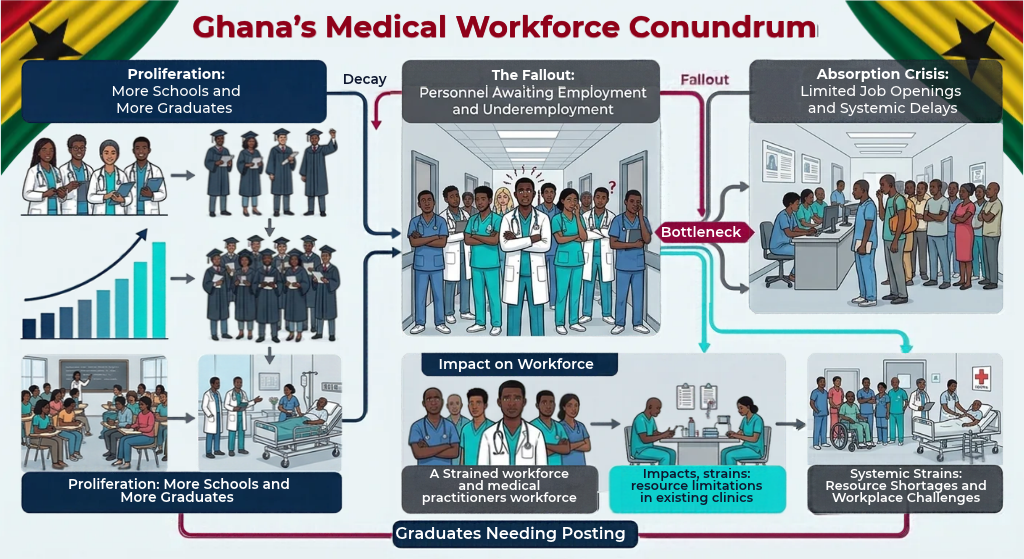
Ghana has moved within two decades from an era of scarcity of medical schools to an era of proliferation. From two medical schools admitting fewer than 200 students per year in the 1990s, the country now has over twelve accredited schools producing more than 1,200 graduates annually. This expansion was driven by legitimate population health needs but has not been matched by a corresponding expansion in postgraduate training capacity, employment, and financial clearance. The result is a growing cohort of qualified doctors trapped in queues — for housemanship, for permanent registration, and for paid employment — with consequent loss of years, demoralisation, and accelerated emigration. This editorial examines the historical trajectory, quantifies the current bottleneck, compares Ghana’s experience with international standards, and argues for a fundamental shift from uncoordinated proliferation to coordinated, needs-based workforce planning.
The Golden Age That Was
For the first three decades after independence, medical education in Ghana was deliberately elitist and deliberately small. The University of Ghana Medical School (est. 1964) and the Kwame Nkrumah University of Science and Technology School of Medical Sciences (est. 1975) admitted 50 to 100 students per year. Selection was rigorous, training was apprenticeship-based, and the social contract was clear: the State would train you, and the State would employ you.
The pathway was linear and predictable:
MBChB
Immediate housemanship
Medical and Dental Council (MDC)
permanent registration
Employment by the
Ministry of Health (MOH) or a Teaching Hospital. There was no concept of an "unemployed doctor."
That social contract has collapsed.
The Proliferation:
More Schools, More Students
The last 15 years have seen an unprecedented expansion. Public Universities now include University of Ghana, KNUST, University for Development Studies, University of Cape Coast, University of Health and Allied Sciences. Private institutions include Klintap University College of Health and Allied Sciences, Family Health Medical School, Accra College of Medicine, among others.
Collectively, Ghana now admits an estimated 1,200 – 1,500 medical students annually. In addition, 300 – 500 Ghanaian students graduate annually from foreign medical schools and return to sit the MDC registration examination.
This expansion was not irrational. Ghana’s population has grown from 18.9 million in 2000 to 34.5 million in 2024, with a doctor-to-population ratio of approximately 1:7,500, far below the WHO recommended 1:1,000. The policy intent was to close the gap. The problem is that we expanded the front end of the pipeline without expanding the middle and the end.
The Anxiety of the Modern Ghanaian Medical Student
The modern Ghanaian medical student’s anxiety is qualitatively different from that of previous generations. It is no longer examination anxiety; it is existential and systemic anxiety.
The Barrier to Acquiring the MBChB
Medical education has become prohibitively expensive, particularly in private schools where fees range from GHS 70,000 to GHS 120,000 per annum. Students endure prolonged training due to industrial actions, infrastructure deficits, and faculty shortages.
The MDC Interface
The MDC, mandated by Act 857 to regulate training and practice, has become a bottleneck rather than a facilitator. The registration examination pass rate for foreign-trained doctors hovers between 30-50%, creating a second pool of stranded graduates.
Queuing for Housemanship: The National Shame
Housemanship is the compulsory 2-year rotational internship required for permanent registration. Accredited centres — Korle Bu, Komfo Anokye, Cape Coast, Tamale Teaching Hospitals, 37 Military Hospital, and a few regional hospitals — have a combined capacity of approximately 400-500 house officers per cohort. Yet we produce over 1,200 graduates per cohort. In 2023 and 2024, over 800 graduates waited 12-18 months for a housemanship slot. During this period, clinical skills decay and mental health deteriorates
Financial Clearance Delays: Employment Without Pay
Even after completing housemanship, the doctor must await financial clearance from the Ministry of Finance — a process that currently takes 12-24 months. The Ghana Medical Association has documented cases of doctors owed 14-18 months salary arrears
The cumulative loss is stark: 1 year lost to delayed academic calendar + 1.5 years waiting for housemanship + 1.5 years waiting for clearance = 4 productive years lost.
BOX 1: The Legal Status of the Medical And Dental Council — Regulator, Not Constitutional Gatekeeper
Legal Basis: The Medical and Dental Council (MDC) is not a body created by the 1992 Constitution. It is a creature of statute, established under Parliament’s power in Articles 190 and 195 of the Constitution to create regulatory bodies. Its current governing law is the Health Professions Regulatory Bodies Act, 2013 (Act 857), Part Two, Sections 27-50, which repealed the Medical and Dental Act, 1972 (NRCD 91).
Statutory Object — Section 27, Act 857: “To secure in the public interest the highest standards in the training and practice of medicine and dentistry.”
Regulator or Gatekeeper? Parliament intended it as a regulator, with gatekeeping as an instrument of regulation, not an end in itself. Its core functions under Section 28 include (a) prescribing standards for training and practice, (b) accrediting institutions, (c) registering practitioners, (d) prescribing and conducting examinations, and (e) disciplinary control.
Has its Jurisdiction been Amended by the Constitution? No. No constitutional amendment has altered the MDC’s jurisdiction. Changes have been by ordinary statute only (NRCD 91 → Act 857).
Current Context and Disclaimer: In recent months, public discussion has arisen regarding the mode of prescribing conditions for registration and examinations under Act 857, particularly the relationship between administrative guidelines and Legislative Instruments envisaged under Section 49.
We note that questions relating to this issue are currently pending before the High Court in the matter of Federation of Ghana Medical Students Associations (FGMSA) v. Medical and Dental Council. The grant of an interim order on 21st October 2026 is a matter of public record.
The substantive merits of that case are yet to be determined by the court. This Box and the accompanying editorial make no comment on the merits, outcome, or conduct of the parties in that pending litigation. The views expressed herein constitute bona fide academic commentary on health workforce policy and statutory interpretation, offered in the public interest under Article 21(1)(a) of the Constitution, and are not intended to prejudice or interfere with the fair determination of the pending case.
The Policy Vacuum:
Who decides how many doctors Ghana needs?
At present, no single entity is accountable for health workforce planning. Universities admit based on internal capacity to generate internally generated funds, not national need. Ministry of Health plans employment based on annual budget ceilings, not epidemiological need. MDC sets quotas and accredits schools but lacks the statutory power to enforce intake ceilings linked to employment.
We need a formal, statutory Joint Health Workforce Planning Committee comprising MOH, GHS, MDC, Ministry of Finance, Ministry of Education, and Heads of Medical Schools. This body should
- conduct a 10-year needs-based projection,
- determine total national intake,
- allocate that intake proportionally to schools based on faculty strength and bed capacity, and
- implement tracking from Year 1: every medical student issued an MDC index number on admission, enabling real-time forecasting as done by the General Medical Council (UK).
International Benchmarking
Ghana’s paradox — a doctor shortage coexisting with unemployed doctors — is a planning failure, not a production failure. In the United Kingdom, Health Education England centrally controls intake to match Foundation Programme posts. In the United States, the National Resident Matching Program ensures >94% match rate.
The WHO’s Global Strategy on Human Resources for Health: Workforce 2030 (2016) explicitly warns against “production without absorption” as a driver of brain drain. Ghana is a textbook case. The doctor who waits 2 years for housemanship will inevitably sit for PLAB or USMLE. Brain drain is not the cause of our shortage; it is the rational response to our bottleneck.
The Population Reality
Ghana’s population grows at 2.1% annually, adding ∼700,000 people per year. To achieve 1:5,000 by 2030, we need to produce and retain ∼1,000 doctors per year. That is achievable. But producing 1,500 and retaining only 400 is wasteful. While Accra and Kumasi have a surplus of doctors queuing for jobs, the Upper West, North East, and Oti Regions have less than 0.5 doctors per 10,000 population
Health providers may do the following diagnosis for Otitic barotrauma:
Recommendations
- Moratorium on new medical schools until housemanship capacity equals graduate output.
- Enforce MDC quotas with penalties for over-enrolment.
- Expand housemanship accreditation to well-equipped regional and district hospitals.
- Automatic financial clearance upon successful completion of housemanship.
- Implement MDC tracking from Year 1.
- Publish an annual Health Workforce Report detailing intake, graduation, housemanship placement, and employment.
In Conclusion, Medical education in Ghana has reached an inflection point. We have succeeded in producing doctors in numbers our forefathers could not have imagined. We have failed in creating a system to train, register, and employ them with dignity. The question is no longer “Should we train more doctors?” The question is “Can we honour the doctors we already train?” If we do not fix absorption, we will continue to subsidise the NHS and the American health system with Ghanaian-trained doctors, while our own districts remain bereft.
We must choose: Do we want doctors, or do we merely want medical school graduates?
Share Post On:
Recent Posts
Categories
References:
- Medical and Dental Council Ghana. Annual Report 2023. Accra: MDC; 2024.
- World Health Organization. Global Strategy on Human Resources for Health: Workforce 2030. Geneva: WHO; 2016.
- Ghana Medical Association. Communiqué on Unemployed Doctors and Delayed Housemanship. Accra: GMA; 2024.
- Ministry of Health. Human Resources for Health Policy and Plan 2020-2030. Accra: MOH; 2020.
- General Medical Council. The State of Medical Education and Practice in the UK. London: GMC; 2023.
- Republic of Ghana. Health Professions Regulatory Bodies Act, 2013 (Act 857). Ghana Gazette; 2013.
- Republic of Ghana. Constitution of the Republic of Ghana, 1992. Articles 21(1)(a), 126(2), 190, 195.


Get in Touch
Read doctor-produced health and medical information written for you to make informed decisions about your health concerns.
Address
Adenta
info@grovehealth.net
Working Hours
Mon - Friday @ 8am - 5 pm