
The Anatomy of Institutional Decay in a Health Facility
What is a 'Crime Scene'?
In law, a crime scene is a place where a crime has been committed and where evidence can be collected.
When we say a hospital has become a crime scene, we do not necessarily mean police tape on the ward.
We mean:
A health institution where the core mission – healing – has been subverted, and where fraud, theft, abuse, and professional misconduct have become systemic, routine, and protected. It ceases to be a place of care and becomes a place where patients are exploited.
Dimensions of the Problem
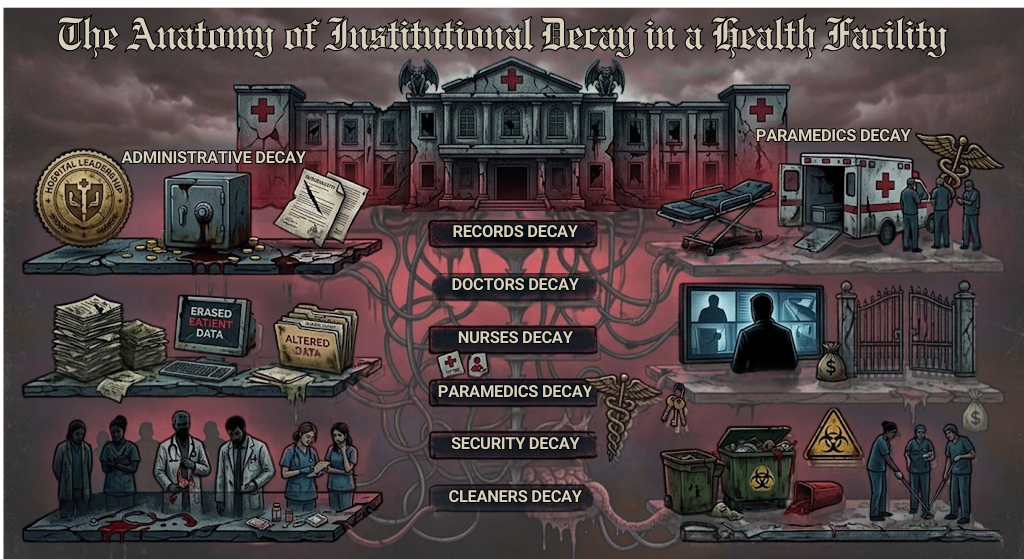
Crime in a hospital is not limited to one group. It is layered:
-
Administrative:
Diversion of drugs and consumables, inflation of procurement invoices, ghost workers on payroll, sale of appointment letters, extortion for bed allocation.
-
Accounts / Records:
Manipulation of bills, double billing, charging patients for free services under NHIS, pocketing cash payments, falsifying receipts, selling patients' data.
-
Doctors:
Illegal private practice within public time, demanding informal payments before surgery, falsifying medical reports for insurance/court, unnecessary investigations for kickbacks, sexual exploitation of patients/students.
-
Nurses / Midwives:
Sale of hospital supplies - gloves, gauze, spirit, detergents, diversion of free maternal health drugs, charging for injections and dressings.
-
Paramedics / Lab / Radiology:
Private labs referral for commission, using hospital reagents for private clients, extorting for quick results.
-
Orderlies, Cleaners, Janitors, Security:
Acting as agents - collecting money for access to doctors, selling queue positions, extorting to allow visitors, stealing patients' properties, linen, food.
The sum is a shadow economy that runs parallel to the official hospital.
The Motivation of Crime Among Different Cadres
-
1. Administrators:
Greed, access to large budgets, weak procurement oversight.
-
2. Account officers:
Low pay + high cash flow + poor receipting systems.
-
3. Doctors:
Sense of entitlement, poor remuneration vs. market value, lack of supervision by regulatory councils.
-
4. Nurses:
Work overload, burnout, perceived neglect by management, opportunity due to direct control over ward stock.
-
5. Paramedics:
Technology-driven monopoly - "only I can do this scan quickly".
-
6. Orderlies / Cleaners:
Survival crime. Lowest paid, often casual workers, see everyone else taking, feel justified to take their share.
-
7. Common driver across all:
Impunity. When nothing happens after the first theft, the second becomes culture.
Specific Actions That Constitute Crime
- Stealing and resale of government drugs and consumables
- Extortion - "Pay before you see doctor"
- Falsification of records and bills
- Ghost staff and payroll fraud
- Sexual harassment and abuse of patients and junior staff
- Assault and verbal abuse leading to deterrence of care
- Diversion of patients to private clinics owned by staff
- Fraudulent use of hospital identity to solicit money from public
- Deliberate breakdown of equipment to justify private referral
All these are punishable under Criminal Offences Act, 1960, Act 29, and professional codes.
Patients Complaints Channels and How They Are Addressed
An ideal institution must have:
- Visible complaints desk with a neutral officer
- Complaint boxes, hotline, WhatsApp number, QR code linked directly to management, not to the accused departments
- Client service charter that states time frame for resolution – 48 hours, 7 days
- Acknowledgement, investigation, feedback loop
- Patient must get written outcome
In many failed institutions, complaints go to the very people committing the fraud. The form is collected, torn, and the complainant is victimized on next visit.
Initial Discipline Measures Against Those Caught
- According to Ghana Labour Act and hospital disciplinary codes:
- Immediate interdiction or suspension pending investigation
- Issuance of query within 24-48 hours
- Preservation of evidence - CCTV, receipts, stock cards
- Removal from sensitive points - e.g., pharmacy, revenue point
- Referral to internal audit
This must be prompt and non-selective. The moment management negotiates with a thief, the system collapses.
Investigations Committee Report and Actions
A credible committee must be:
- 1. Independent, mixed - includes external member
- 2. Has Terms of Reference, timeline, power to invite witnesses
- 3. Report must state findings of fact, culpability, quantum of loss, recommendation
Actions to be taken and communicated to rest of staff:
- Publication of summary of findings on notice board - without naming if legally advised, but with actions taken.
- Staff durbar to discuss report.
- Restitution, demotion, dismissal, or prosecution
Communication is deterrence. Silence is complicity.
Reasons Why Committee Report May Not Be Implemented
This is the heart of institutional failure:
-
1. The implementers are themselves culpable.
The Medical Director, Administrator, or Head of Accounts is part of the network and cannot prosecute himself.
-
2. Godfatherism:
Offenders are protected by board members, politicians, chiefs.
-
3. Fear of exposure:
Full implementation will reveal how deep the rot is and embarrass the institution.
-
4. Union blackmail:
Threat of strike if their member is punished.
-
5. Trade-off culture:
"He knows our secrets, let's manage it internally."
How Inaction Sends the Wrong Signal
When a report is shelved:
- Honest staff become demoralized – “Why should I be honest?”
- Criminal staff become emboldened and recruit others
- Patients lose trust and resort to self-medication or traditional healers
- A new norm emerges: crime is the approved way to succeed in that hospital.
- Whistleblowers are punished, not perpetrators
Inaction is not neutral. It is active endorsement of crime.
The Chances of Law Enforcement Wading In
When internal mechanisms fail, external intervention becomes inevitable:
- EOCO for procurement and payroll fraud
- Ghana Police CID / OSP – Office of Special Prosecutor for corruption
- Auditor General for financial misappropriation
- A patient who dies after extortion can trigger homicide investigation and media outrage
Law enforcement entry is always messier, more public, and more damaging than internal resolution. It often ends with closure of units, loss of accreditation, and mass dismissal.
Duty of Regulatory Bodies
-
Medical and Dental Council:
To discipline doctors for extortion, negligence, diversion of patients, sexual misconduct. Can suspend license.
-
Nurses and Midwifery Council:
For misconduct, drug diversion.
-
Allied Health Professions Council:
For lab, radiology fraud.
-
Pharmacy Council:
For drug theft.
These bodies have powers to investigate even without institutional referral. Failure of institution to refer is itself professional misconduct.
Lessons for Other Institutions
- No institution is too sacred to become a crime scene. A stethoscope does not confer holiness.
- Systems beat sermons. Cashless billing, electronic stock management, CCTV, and rotation of staff at revenue points prevent more crime than workshops on ethics.
- Implement your own reports, even if it hurts.
- Protect whistleblowers publicly.
- Invite external audit every year, not when scandal breaks.
- Leadership must be seen to be clean.
- You cannot lead a cleanup if your hands are dirty.
In conclusion,
A hospital becomes a crime scene not in one day. It starts with one unpunished small theft of gloves, then drugs, then money, then dignity, then lives.
The cure is not more committees. The cure is courage to implement the last committee report.
When healing institutions lose their moral authority, patients die twice – once from disease, and once from exploitation.
The most dangerous hospital is not the one without drugs. It is the one where the staff have become the disease they were employed to cure.
Share Post On:
Recent Posts
Categories


Get in Touch
Read doctor-produced health and medical information written for you to make informed decisions about your health concerns.
Address
Adenta
info@grovehealth.net
Working Hours
Mon - Friday @ 8am - 5 pm