
All you need to know about Continuous Positive Airway Pressure (CPAP)
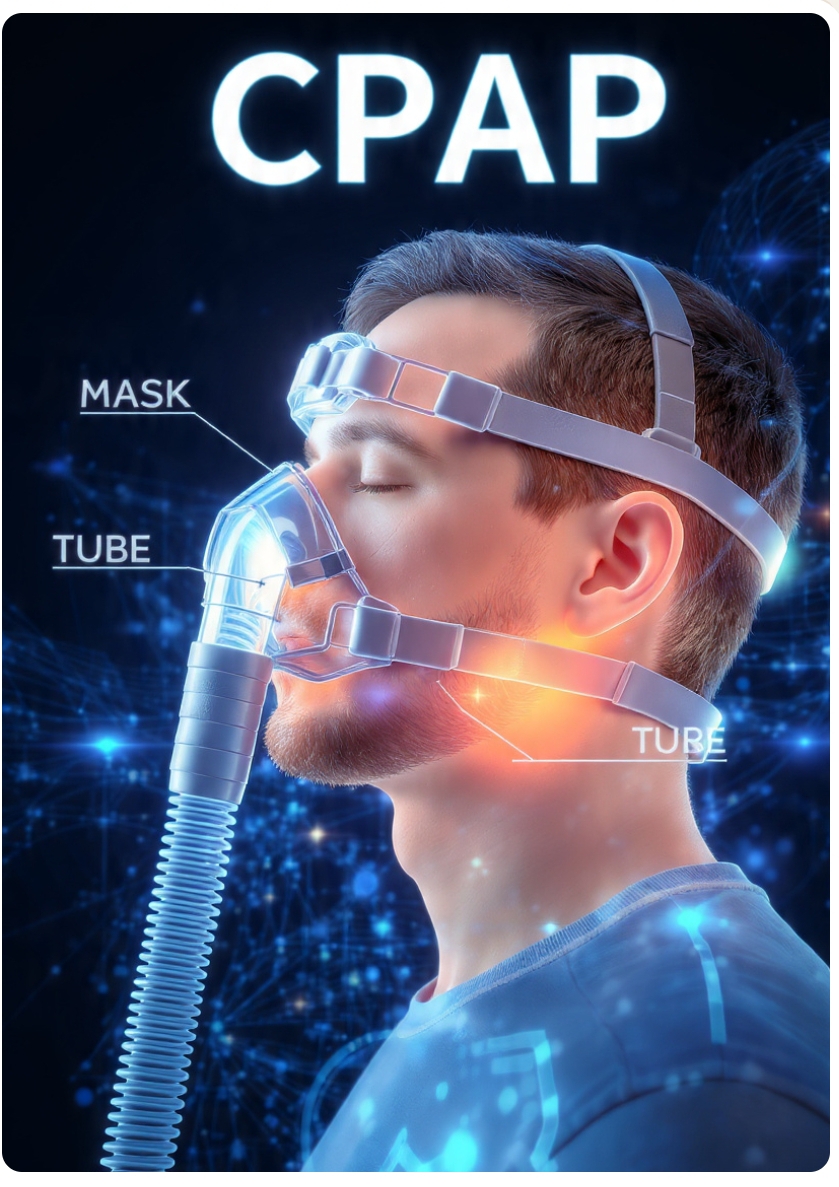
Overview
Continuous Positive Airway Pressure (CPAP) is a mode of positive airway pressure therapy that delivers a continuous flow of air at a constant pressure to keep the upper airway open during spontaneous breathing. The pressure is measured in cm H₂O and is maintained during both inspiration and expiration.
Introduction / Historical Perspective
CPAP is the first-line treatment for obstructive sleep apnea (OSA) and is widely used in hospital and home settings for respiratory support. It avoids intubation by providing non-invasive ventilatory support.
CPAP was introduced in the 1980s for OSA treatment and has since become the gold standard for managing upper airway collapse during sleep. It evolved from positive end-expiratory pressure (PEEP) used in mechanical ventilation.
What Pathology Does CPAP Target?
CPAP primarily targets:
Obstructive Sleep Apnea (OSA): Collapse of the upper airway during sleep
Central Sleep Apnea/Cheyne-Stokes respiration in heart failure
Atelectasis and hypoxemia in acute respiratory failure
Respiratory failure, COPD, heart failure in selected cases.
Mechanism of Action
- 1. Prevents collapse of the pharyngeal airway during sleep
- 2. Increases functional residual capacity (FRC) and opens collapsed alveoli
- 3. Improves ventilation-perfusion (V/Q) matching and oxygenation
- 4. Reduces atelectasis and right-to-left intrapulmonary shunt
- 5. Decreases work of breathing by improving lung compliance.
Types of CPAP
-
Fixed CPAP:
Delivers one constant pressure set by the clinician
-
Autotitrating CPAP (AP):
Adjusts pressure automatically based on breathing patterns
-
Bilevel PAP (BiPAP/BIPAP):
Higher pressure during inhalation, lower during exhalation. Used when CPAP is not tolerated or for mixed respiratory failure.
Effectiveness
- CPAP consistently reverses upper airway obstruction in OSA
- Reduces apnea-hypopnea index (AHI) to <5 events/hour in most compliant users
- Improves sleep quality, reduces snoring, daytime sleepiness, and improves concentration and memory
- Can lower blood pressure and alleviate pulmonary hypertension.
Compliance Figures
Adherence is the main challenge:
- Long-term high adherence: ∼45% of OSA patients at 24 months
- Non-adherent: ∼39% at 24 months
- Low-adherent: ∼16%
- Classic threshold: 46-83% of patients are non-adherent if defined as <4 hours/night
- Predictors of better adherence: Higher BMI, higher Epworth Sleepiness Scale score, witnessed apneas, and symptom improvement
- Predictors of poor adherence: Antidepressant use, CPAP-induced sleep disturbances
- Critical period: Adherence patterns stabilize within the first 3 months.
Widespread Use of CPAP
Used in:
- Home therapy for OSA
- Hospitals for acute hypoxemic respiratory failure, post-extubation support, and palliative care
- Neonates, children, and adults.
Benefits
- Improved sleep quality and reduced daytime sleepiness
- Better concentration, memory, cognitive function
- Reduced blood pressure in hypertensive OSA patients
- Improved mood, less anxiety/depression.
- Better productivity and sleep for bed partner.
Level of Tolerance
Tolerance varies. Common barriers:
- Mask discomfort, skin abrasions, rash, conjunctivitis
- Claustrophobia, air leaks, dry mouth/nose
- Sensation of expiratory resistance.
Solutions include ramp feature, nasal pillows, chin straps, mask refitting, and motivational interviewing.
How to Measure Effective Usage
Objective metrics from machine data:
- Usage hours/night; ≥4 hours is standard cutoff
- Residual AHI on CPAP
- Leak rates, pressure delivery
Clinical outcomes:
- Improved ESS score, reduced daytime sleepiness
- Patient-reported symptom improvement
Tele-monitoring is increasingly used for real-time adherence tracking.
Pros and Cons
Pros
Measures the tracer uptake.
- Non-invasive, avoids intubation
- High efficacy for OSA when used.
- Safe for all ages
- Reversible, no sedation needed.
Cons
- Poor adherence is common
- Mask-related side effects, claustrophobia
- Not a cure; lifelong therapy usually required
- Less effective for full ventilation support.
When to Stop Use of CPAP
-
OSA:
Usually lifelong unless significant weight loss, surgery, or anatomical correction resolves OSA
-
Acute use:
Stop when underlying condition resolves and patient maintains adequate oxygenation without it
-
Intolerance:
If severe side effects persist despite troubleshooting, switch to APAP, BiPAP, or consider alternative therapies
-
Guidance
Always stop under physician guidance after repeat sleep study if indicated.
Conclusion
CPAP remains the most consistently efficacious and safe treatment for obstructive sleep apnea. Its success depends more on patient adherence than on physiological severity. Behavioral interventions, proper mask fitting, and early support in the first month significantly improve long-term use.
Share Post On:
Recent Posts
-
Overview Of The Parotid Gland
-
Stridor Demystified
-
Management of Septal Deviation
-
Anatomy of Nasal Septum / Septal Pathology
-
Comprehensive Overview of Infectious Mononucleosis
-
Types of pulse oximeters
-
Laser In Modern Otorhinolaryngology (Orl) Practice
-
Comprehensive Overview of Choanal Atresia
-
Comprehensive Overview of Adenoids & Adenoid Facies
-
Synoptic Overview Of Glue-Ear = Serous Otitis Media / Otitis Media With Effusion (OME)
-
Plummer-Vinson Syndrome / Paterson-Brown-Kelly Syndrome
-
All you need to know about Continuous Positive Airway Pressure (CPAP)
-
Nuggets of ORL-Head & Neck Surgery
-
Nuggets of ORL- Operative Surgery
-
Overview of AI Tools In Modern ORL Practice
-
Nuggets of ORL-LARYNGOLOGY
-
All You Need To Know About PET Scan
-
Nuggets of ORL-PAEDIATRICS
-
Nuggets of ORL-OTOLOGY
-
Nuggets of ORL-RHINOLOGY
-
Nuggets of Otorhinolaryngology-Basic sciences
-
Anatomy of the Muscles of the Soft Palate
-
Ethmoidal Arteries Ligation for Epistaxis
-
Submucous Cleft Palate (SMCP)
-
Approach to Ligation of the External Carotid Artery
-
Approach to Managing a 3-Year-Old Boy with a Foreign Body in the nasal cavity.
-
Approach to Managing a 3-Year-Old Boy with a Foreign Body impacted in the ear canal.
-
Endoscopic Sphenopalatine Artery Ligation (ESPAL) for Epistaxis
-
Surgical Management of Epistaxis
-
Technique of Incision and Drainage of Septal Hematoma/Septal Abscess
-
Upper Aerodigestive Tract Foreign Body Impaction
-
Incision and Drainage of Hematoma Auris
-
Rigid Bronchoscopy for Retrieval of Foreign Bodies in Children
-
Foreign Body Impaction in the Larynx, Trachea, and Bronchi
-
Leadership Position is a Tool, not a Trophy
-
Carcinoma of the Oropharynx
-
Peritonsillar Abscess
-
Ethics of Doctor-Patient Relationship
-
Doctor-Patient Relationship Case Scenarios
-
Asymmetrical Tonsils and Approach to Evaluation and Management
Categories
Get in Touch
Read doctor-produced health and medical information written for you to make informed decisions about your health concerns.
Address
Adenta
info@grovehealth.net
Working Hours
Mon - Friday @ 8am - 5 pm