Overview
Editorial - Part 2
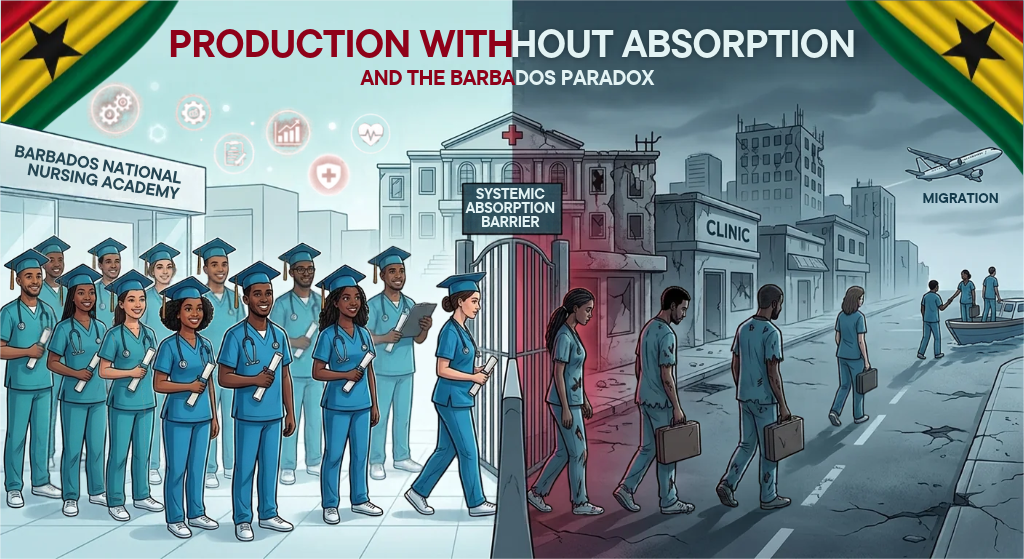
If the crisis of doctors in Ghana is a bottleneck, the crisis of nurses is a flood. Ghana now admits more than 50,000 students annually into nursing, midwifery and allied health programmes, while recruiting only 10,000 to 15,000 health professionals per year into the public service. The result is a backlog of over 105,000 trained health professionals waiting for employment, many for 3 to 5 years, despite a widely acknowledged shortage of nurses in Ghanaian hospitals.
This editorial, a companion to our earlier editorial on medical education, quantifies the cost of training a nurse, examines the financial clearance trap, interrogates the paradox of shortage amidst surplus, and critically evaluates the Government’s labour export programme, exemplified by the Ghana-Barbados agreement. We argue that managed migration cannot substitute for domestic absorption, and that without a statutory cap on intake linked to employment, Ghana will continue to subsidise foreign health systems with Ghanaian-trained nurses.
From Doctors to Nurses — The Same Disease, At Scale
In our previous editorial, we described the conundrum of modern medical education in Ghana: proliferation without absorption. We produce doctors we cannot place in housemanship, cannot register promptly, and cannot pay.
The nurses’ story is the same disease, but at a scale that dwarfs the doctors’ crisis.
With doctors, we speak of 1,200 to 1,500 graduates per year. With nurses, we speak of tens of thousands. The Ministry of Health itself has disclosed that more than 50,000 students are admitted annually into nursing, allied health and related programmes, while the country recruits only 10,000 to 15,000 health professionals each year.[1]
Unless we do fix absorption for nurses, we will not fix the health system. Nurses are the backbone of every ward, every CHPS compound, every theatre, every ICU. When they wait at home, the system bleeds.
The Proliferation:
Over 100 institutions, one uncoordinated system
The last 15 years have seen an unprecedented expansion. Public Universities now include University of Ghana, KNUST, University for Development Studies, University of Cape Coast, University of Health and Allied Sciences. Private institutions include Klintap University College of Health and Allied Sciences, Family Health Medical School,
Ghana has moved from a handful of state nursing training colleges to a vast, decentralised training ecosystem. The Nursing and Midwifery Council (NMC) now accredits over 100 Nursing and Midwifery Training Colleges — public Ministry of Health colleges, Christian Health Association of Ghana (CHAG) / mission colleges, and a rapidly expanding private sector — alongside university Schools of Nursing and Midwifery at the University of Ghana, KNUST, University of Cape Coast, University for Development Studies, University of Health and Allied Sciences, and others.[2]
Each institution admits based on its own capacity, its own infrastructure, and, frankly, its own need for internally generated funds. There is no single national intake ceiling. There is no statutory body that says: “Ghana needs X nurses in 2028, therefore we will admit Y students in 2025.”
The result is predictable. It pipeline is full at the front end and blocked at the back end.
What does it cost to train one nurse?
The public debate rarely prices the waste. We must.
Public Nursing Training College — 3-year Diploma in Registered General Nursing (RGN):
Fees paid by the student or family range from approximately GHS 1,500 to GHS 4,500 per year depending on the college, or GHS 4,500 to GHS 13,500 for the full programme. This is only the visible cost.
The State pays the hidden cost: tutors’ salaries, clinical infrastructure, teaching hospital supervision, NMC examination subsidy, and, when paid, the trainee allowance of GHS 400 per month, equivalent to GHS 14,400 over three years.
Conservative societal cost per diploma nurse: GHS 35,000 to GHS 60,000 for 3 years.
Private College / University BSc Nursing — 4 years:
Fees alone range from GHS 5,000 to GHS 15,000 per year, or GHS 20,000 to GHS 60,000 for the course, before living costs, accommodation, books, uniforms, and transport for clinical placement.
Multiply a conservative GHS 40,000 by 50,000 admissions per year, and the annual national investment in nursing education exceeds GHS 2 billion. A significant proportion of that investment is currently sitting at home, unemployed, its clinical skills decaying.
This is not merely an employment problem. It is a fiscal problem.
Trained, Then Abandoned: The Financial Clearance Trap
The mechanism of abandonment is well known to every Ghanaian health worker: financial clearance.
A nurse may complete training, pass the NMC licensure examination, and even be posted to a facility — but she cannot be paid until the Ministry of Finance issues financial clearance. Without clearance, she is a volunteer in all but name.
In 2024, 13,500 nurses, midwives and other health professionals were posted without financial clearance. Many worked for close to a year without pay. The Coalition of Unpaid Nurses and Midwives marched on the Ministries of Finance and Health in October 2025 over 11 months of arrears. [1]
As of November 2026, the Ministry of Health has stated that those 13,500 are now on payroll and their arrears have been cleared. Financial clearance has been secured for 8,000 more out of a planned 16,000 to 16,500 recruitments for 2026, with the next 8,000 to follow. Recruitment is being done in order of seniority, starting with the 2021 cohort.[1]
We welcome this progress. But the arithmetic remains brutal. Even if Government recruits 16,500 in 2026, it will admit over 50,000 new students in the same year. The queue cannot clear. A nurse who graduated in 2021 and is only now being employed in 2026 has lost five productive years. Skills decay. Confidence erodes. Mental health deteriorates. Some will have already left for the United Kingdom, Canada, or the Gulf through private agencies.
And the rule that should have prevented this — no posting without clearance — is only now being enforced as policy for 2026. It must become law, not a ministerial promise.
The Paradox:
The most damning feature of the Ghanaian nursing crisis is that it is not a crisis of overproduction. It is a crisis of under-absorption.
The Registrar of the NMC has told Parliament’s Health Committee that Ghana still requires more than 100,000 nurses to improve its nurse-to-patient ratio, with a current ratio of approximately 1 nurse to 830 people, far from ideal, and 1:1 in critical care. She added: “Most of the hospitals when you go, they are empty and the nurses are not there.”[3]
Visit a CHPS compound in Upper West, North East, or Oti. Visit a district hospital in Volta or Northern Region. Visit even Korle Bu Teaching Hospital at night. You will find wards manned by two nurses for 30 patients, a midwife covering labour ward alone, an ICU with beds but no critical care nurses.
Meanwhile, over 105,000 trained health professionals wait at home.[1]
How can a country be short of nurses and have 105,000 unemployed nurses at the same time?
The answer is not need. It is budget ceiling. As the Minister of Health has candidly put it: “You can only recruit what your budget can pay.”
We have a health need, but we do not have a health workforce budget that matches that need. We plan employment based on annual fiscal ceilings, not epidemiological need. We plan training based on institutional capacity to admit, not national need. The two plans never meet.
This is exactly what the WHO’s Global Strategy on Human Resources for Health: Workforce 2030 (2016) warned against: “production without absorption” as a driver of brain drain and system failure.[4]
The Barbados Paradox: Exporting For Foreign Exchange?
It is in this context that the Ghana-Barbados agreement must be understood.
The History:
In 2019, Ghana and Barbados signed a Memorandum of Understanding at Jubilee House for the recruitment of Ghanaian registered nurses to Barbados. The initial cohort was 120 nurses, later described as 375 in subsequent discussions. The framework provided for remuneration at par with Barbadian nurses, and for joint education programmes.[5]
At the time, the then President stated: “We have a surplus of nurses in Ghana, and placing them all in our public health system is one of my headaches.”
In 2020, the first batch of 95 to 120 nurses arrived in Bridgetown to work at the Queen Elizabeth Hospital. Barbados, facing its own acute nursing shortage, welcomed them.
In 2024, a third batch was announced. The then Minister of Health explained the rationale in economic terms: Ghana produces around 55,000 nurses annually, more than the system can absorb, and “They send back remittances, which helps boost the economy here.”[5]
Today, this has expanded into the Ghana Labour Exchange Programme, with Memoranda of Understanding with about 15 countries, including Grenada (61 health workers in the most recent cohort), Antigua and Barbuda (over 120), Barbados (a further 112 approved), plus Germany, the United States, Jamaica, Seychelles, and the United Kingdom. [1]
The Government's Case:
Proponents argue, with some legitimacy, that:
- Managed migration relieves the backlog without burdening the MoH budget;
- Remittances provide foreign exchange to families and to the national economy;
- Nurses gain international exposure and return with enhanced skills;
- A state-to-state agreement is safer than chaotic, private agency-driven migration that exploits nurses.
These are not trivial arguments. A nurse earning in Barbados and remitting to her family in sawla is better off than a nurse sitting at home for five years unpaid.
The Counter-Case:
But the Barbados model, as currently structured, raises three serious ethical and economic questions that we cannot avoid as a profession.
First, we are not exporting the unemployed fresh graduate. The Barbados MoU requires a minimum of three years’ experience and specialist skills — critical care, cardiac catheterisation, emergency, operating theatre, ophthalmology. We are exporting our best nurses — the ICU nurse, the theatre nurse, the emergency nurse — the very cadres our own ICUs and theatres lack. The unemployed 2023 graduate remains at home. The experienced 2018 graduate leaves.
Second, Ghana never recovers the training investment. We have spent GHS 35,000 to GHS 60,000 to train each nurse. Barbados pays her salary, which is proper. But no training levy returns to the MoH training budget. Remittances go to families, not to the Nursing Training Colleges. In economic terms, Ghana is subsidising the health system of a richer country with Ghanaian taxpayers’ money.
Third, it creates a perverse incentive. If the backlog can be called a “surplus” and exported for foreign exchange, why fix financial clearance? Why expand domestic absorption? Why build more CHPS compounds? Export becomes a politically convenient substitute for reform.
A nurse should not have to leave her district hospital empty to go and staff Bridgetown’s Queen Elizabeth Hospital. If we need foreign exchange, we should earn it by exporting goods and services, not by exporting the nurses we paid to train to care for Ghanaians.
We do not oppose migration. Migration is a right. What we oppose is a system that requires migration because it has failed to create domestic employment.
BOX 1:
What Managed Migration Should Look Like — If We Must Export
If Ghana is to continue labour export, it must be on Ghana’s terms, and it must be ethical, transparent, and reciprocal:
- Training Levy: The receiving country or employer pays a training levy per nurse to Ghana’s MoH, earmarked for nursing education and rural retention.
- Return of Service: Contracts include a clear return-of-service and skills-transfer clause, with a guaranteed post on return.
- Protection of Critical Units: No specialist nurse may be recruited from a facility where the critical care / theatre / emergency staffing is below minimum safe levels.
- No Exploitation: All agreements must be government-to-government, with transparent contracts, no recruitment fees charged to the nurse, and full labour rights in the host country.
- Annual Publication: The MoH must publish annually: number exported, cadre, destination, remittances received, and number returned.
This is consistent with the WHO Global Code of Practice on the International Recruitment of Health Personnel (2010), which Ghana has adopted, and which urges destination countries not to recruit in ways that undermine the source country’s health system.[6]
Recommendations
- Cap Intake to Absorption: The NMC, MoH, Ministry of Finance, and Ministry of Education must agree a statutory national intake ceiling, reviewed every three years, based on projected absorption + realistic export quota. No new nursing college should be accredited until housemanship-style clinical capacity equals graduate output.
- No Posting Without Clearance — By Law: Financial clearance must be secured before any posting letter is issued. This 2026 policy must be enacted in regulation.
- Automatic Clearance on Licensure: A nurse who passes NMC licensure should be deemed to have financial clearance within six months, with a published posting timetable
- Expand Absorption, Not Just Production: Prioritise CHPS, district hospitals, and primary care. The 2026 allocation of 6,500 slots to nurses/midwives vs 900 to allied health shows the right instinct — primary care needs nurses most.
- Ethical Export Framework: Implement the Box 1 principles. Publish the Ghana-Barbados and all other MoUs.
- Publish an Annual Health Workforce Report: Intake, graduation, licensure, clearance, posting, attrition, export, and return — by region, by cadre. What is not measured cannot be fixed.
In Conclusion, We have succeeded in training nurses in numbers our forefathers could not have imagined. We have failed in creating a system to employ them with dignity.
The question is no longer “Should we train more nurses?” The question is “Can we honour the nurses we already train?”
If we do not fix absorption, we will continue to train nurses for Barbados, for Grenada, for Antigua, for the NHS, while our own mothers die in labour wards without a midwife, and our own children die in wards without a nurse.
We must choose: Do we want a health system, or do we merely want nursing schools?
References:
- Ministry of Health, Ghana. Statements by Hon. Kwabena Mintah Akandoh on Health Workforce Backlog and Recruitment, October-November 2026. Accra: MoH; 2026.
- Nursing and Midwifery Council, Ghana. List of Accredited Nursing and Midwifery Training Institutions. Accra: NMC; 2026.
- Nursing and Midwifery Council, Ghana. Registrar’s Briefing to Parliament Health Committee on Nurse-to-Patient Ratio and Staffing Needs. Accra: NMC; 2026.
- World Health Organization. Global Strategy on Human Resources for Health: Workforce 2030. Geneva: WHO; 2016.
- Republic of Ghana / Government of Barbados. Memorandum of Understanding on Recruitment of Ghanaian Registered Nurses. Accra / Bridgetown; 2019, with subsequent renewals 2020-2024.
- World Health Organization. WHO Global Code of Practice on the International Recruitment of Health Personnel. Geneva: WHO; 2010
Share Post On:
Recent Posts
Categories

Get in Touch
Read doctor-produced health and medical information written for you to make informed decisions about your health concerns.
Address
Adenta
info@grovehealth.net
Working Hours
Mon - Friday @ 8am - 5 pm