
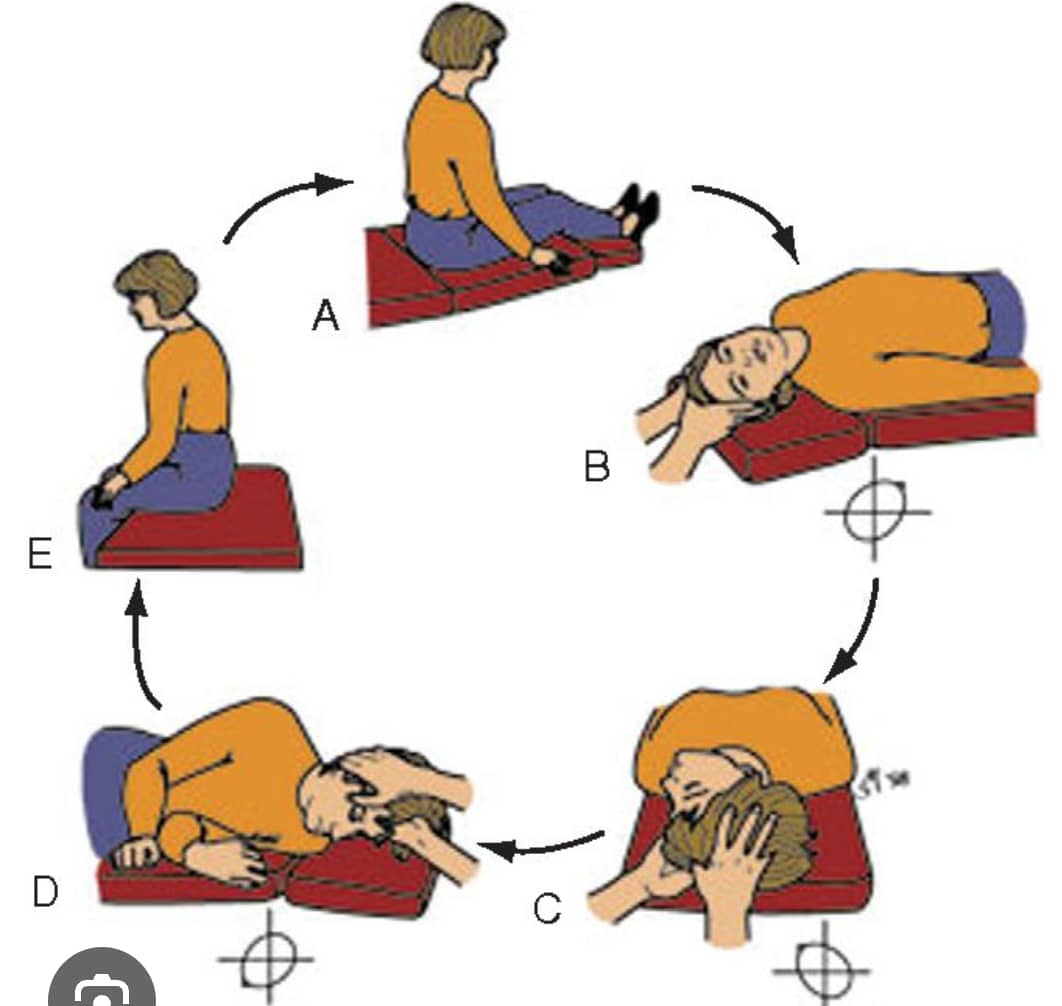
Epley’s maneuver, also known as the canalith repositioning procedure (CRP), is a series of specific head and body movements designed to treat benign paroxysmal positional vertigo (BPPV).
The following is a comprehensive overview of EPLEY’S manoeuvre:
What is BPPV?
-
Definition
BPPV is a vestibular disorder characterized by brief, intense episodes of vertigo triggered by specific head movements.
-
Causes
BPPV is caused by the movement of small calcium particles (otoconia) in the inner ear canals.
How Does Epley's Maneuver Work?
-
Goal
The goal of Epley's maneuver is to move the otoconia out of the inner ear canals and into a part of the ear where they won't cause symptoms.
-
Series of movements
The maneuver involves a series of specific head and body movements, which help to guide the otoconia out of the canals.
Steps of Epley's Maneuver
Step 1: Sit upright with your back straight.
Step 2: Lie down on your back with your head turned to the affected side (the side that triggers the vertigo).
Step 3: Wait for 30 seconds to allow the otoconia to move.
Step 4: Roll onto your side, keeping your head in the same position.
Step 5: Wait for 30 seconds.
Step 6: Sit up and then stand up.
Precautions and Contraindications
-
Precautions
If you have a history of neck or back problems, or if you're experiencing severe vertigo, consult with your healthcare provider before performing Epley's maneuver.
-
Contraindications
Epley's maneuver is not recommended for people with certain medical conditions, such as a recent stroke, brain injury.
Share Post On:
Recent Posts
-
Laser In Modern Otorhinolaryngology (Orl) Practice
-
Comprehensive Overview of Choanal Atresia
-
Comprehensive Overview of Adenoids & Adenoid Facies
-
Synoptic Overview Of Glue-Ear = Serous Otitis Media / Otitis Media With Effusion (OME)
-
Plummer-Vinson Syndrome / Paterson-Brown-Kelly Syndrome
-
All you need to know about Continuous Positive Airway Pressure (CPAP)
-
Nuggets of ORL-Head & Neck Surgery
-
Nuggets of ORL- Operative Surgery
-
Overview of AI Tools In Modern ORL Practice
-
Nuggets of ORL-LARYNGOLOGY
-
All You Need To Know About PET Scan
-
Nuggets of ORL-PAEDIATRICS
-
Nuggets of ORL-OTOLOGY
-
Nuggets of ORL-RHINOLOGY
-
Nuggets of Otorhinolaryngology-Basic sciences
-
Anatomy of the Muscles of the Soft Palate
-
Ethmoidal Arteries Ligation for Epistaxis
-
Submucous Cleft Palate (SMCP)
-
Approach to Ligation of the External Carotid Artery
-
Approach to Managing a 3-Year-Old Boy with a Foreign Body in the nasal cavity.
-
Approach to Managing a 3-Year-Old Boy with a Foreign Body impacted in the ear canal.
-
Endoscopic Sphenopalatine Artery Ligation (ESPAL) for Epistaxis
Categories
Get in Touch
Read doctor-produced health and medical information written for you to make informed decisions about your health concerns.