
Overview
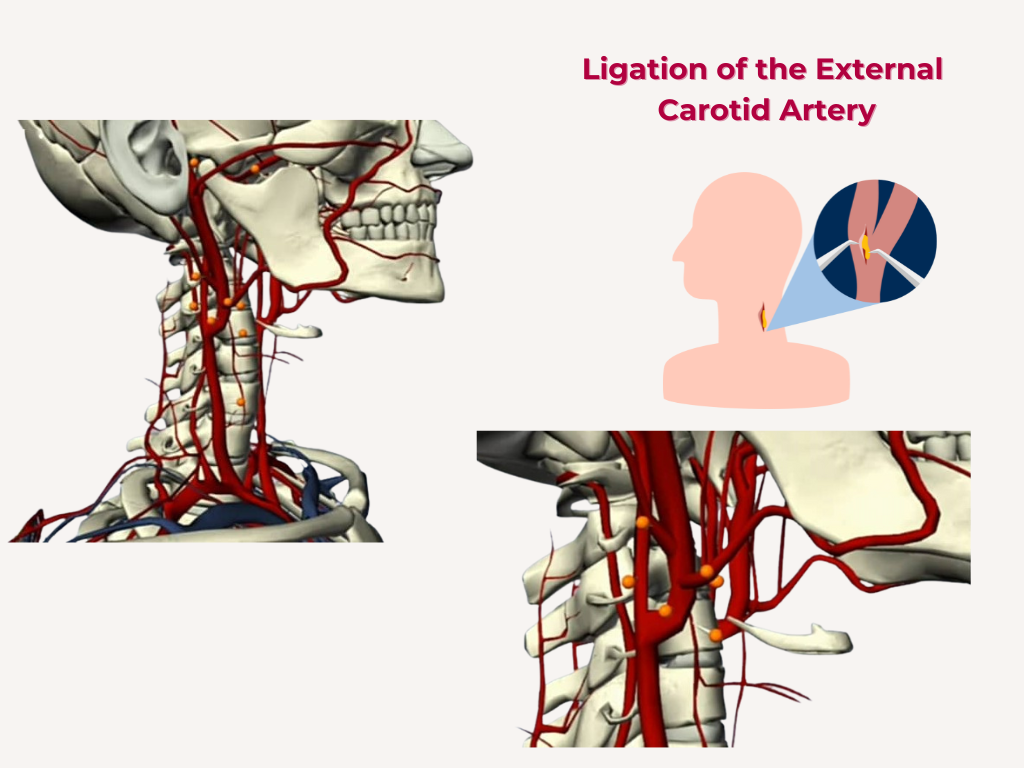
Ligation of the external carotid artery (ECA) is a surgical procedure used to control severe bleeding, manage certain vascular malformations, or as part of tumor resection. Understanding the anatomy, indications, and procedural details is crucial for successful outcomes.
Anatomy of the External Carotid Artery and Branches
The external carotid artery originates from the common carotid artery and supplies blood to the neck and face. Its branches include:
- Superior thyroid artery
- Ascending pharyngeal artery
- Lingual artery
- Facial artery
- Occipital artery
- Posterior auricular artery
- Maxillary artery
- Superficial temporal artery
Variations in branching patterns and anatomical relationships with surrounding structures are common.
Indications
-
1. Control of severe hemorrhage
In cases of trauma or tumor bleeding.
-
2. Management of vascular malformations
Such as arteriovenous malformations (AVMs).
-
3. Tumor resection
To reduce blood supply to tumors.
Contraindications
-
1. Inadequate collateral circulation
Risk of cerebral ischemia or infarction.
-
2. Certain vascular diseases
Such as severe atherosclerosis.
Procedure of Ligation of the External Carotid Artery
Anesthesia
General anesthesia is typically used to ensure patient comfort and control.
Patient Positioning
The patient is positioned supine with the head slightly extended and rotated to the opposite side.
Skin Incision
A skin incision is made along the anterior border of the sternocleidomastoid muscle, typically at the level of the carotid bifurcation.
Dissection
-
1. Subcutaneous tissues and fascia
Dissection is carried through the platysma and deep cervical fascia.
-
2. Carotid sheath
The carotid sheath is identified and opened to expose the carotid arteries.
Identification of the External Carotid Artery
The ECA is identified by its branches and location anterior and medial to the internal carotid artery.
Ligation
-
1. Level of ligation
The ECA is ligated distal to the bifurcation and proximal to the branching point of significant collateral vessels.
-
2. Method
Double ligation with non-absorbable sutures (e.g., silk or polypropylene) is performed to ensure secure occlusion.
-
3. Suture type
2-0 or 3-0 sutures are commonly used.
Closure
The wound is closed in layers, approximating the sternocleidomastoid muscle and platysma, followed by skin closure.
Use of Drain
A drain may be placed to prevent hematoma formation.
Nasal Packing
If the procedure is related to nasal or facial bleeding, nasal packing may be used to control bleeding.
Postoperative Monitoring
-
1. Vital signs
Close monitoring of blood pressure, heart rate, and neurological status.
-
2. Wound care
Monitoring for signs of infection or hematoma.
-
3. Follow-up
Regular follow-up to assess the effectiveness of the procedure and manage any complications.
Ligation of the external carotid artery is a complex procedure requiring precise anatomical knowledge and surgical skill. Understanding the indications, procedural details, and postoperative care is essential for achieving successful outcomes and minimizing complications.
Purpose: The effect of occlusion of the external carotid system on blood flow of the internal maxillary artery was investigated in 16 dogs.
The external carotid system was occluded by ligation or clamping at different levels separately or simultaneously and the blood flow of the internal maxillary artery was measured with an electromagnetic flowmeter before and after each occlusion.
The ligation of the external carotid artery below (low ligation) and above (high ligation) the origin of the occipital, lingual, and facial arteries reduced the blood flow by 61.1% and 71.5%, respectively. Low ligation together with ligation of the lingual artery reduced the blood flow by 73.5%. Multiple ligations (high nd low ligations combined with ligations of the occipital, lingual, and facial arteries) reduced the blood flow by 81.1%. The internal maxillary artery was sectioned after the multiple ligations, and retrograde flow from the distal segment was studied. The flow was only a trace and could not be measured with the flowmeter. Total blood loss from both ends almost equaled the blood flow of the proximal segment, 18.2% of normal.
To conclude, multiple occlusion appears to be the most effective treatment for hemorrhage from the initial part of the internal maxillary artery.
Share Post On:
Recent Posts
-
Stridor Demystified
-
Management of Septal Deviation
-
Anatomy of Nasal Septum / Septal Pathology
-
Comprehensive Overview of Infectious Mononucleosis
-
Types of pulse oximeters
-
Laser In Modern Otorhinolaryngology (Orl) Practice
-
Comprehensive Overview of Choanal Atresia
-
Comprehensive Overview of Adenoids & Adenoid Facies
-
Synoptic Overview Of Glue-Ear = Serous Otitis Media / Otitis Media With Effusion (OME)
-
Plummer-Vinson Syndrome / Paterson-Brown-Kelly Syndrome
-
All you need to know about Continuous Positive Airway Pressure (CPAP)
-
Nuggets of ORL-Head & Neck Surgery
-
Nuggets of ORL- Operative Surgery
-
Overview of AI Tools In Modern ORL Practice
-
Nuggets of ORL-LARYNGOLOGY
-
All You Need To Know About PET Scan
-
Nuggets of ORL-PAEDIATRICS
-
Nuggets of ORL-OTOLOGY
-
Nuggets of ORL-RHINOLOGY
-
Nuggets of Otorhinolaryngology-Basic sciences
-
Anatomy of the Muscles of the Soft Palate
-
Ethmoidal Arteries Ligation for Epistaxis
-
Submucous Cleft Palate (SMCP)
-
Approach to Ligation of the External Carotid Artery
-
Approach to Managing a 3-Year-Old Boy with a Foreign Body in the nasal cavity.
-
Approach to Managing a 3-Year-Old Boy with a Foreign Body impacted in the ear canal.
-
Endoscopic Sphenopalatine Artery Ligation (ESPAL) for Epistaxis
-
Surgical Management of Epistaxis
-
Technique of Incision and Drainage of Septal Hematoma/Septal Abscess
-
Upper Aerodigestive Tract Foreign Body Impaction
-
Incision and Drainage of Hematoma Auris
-
Rigid Bronchoscopy for Retrieval of Foreign Bodies in Children
-
Foreign Body Impaction in the Larynx, Trachea, and Bronchi
-
Leadership Position is a Tool, not a Trophy
-
Carcinoma of the Oropharynx
-
Peritonsillar Abscess
-
Ethics of Doctor-Patient Relationship
-
Doctor-Patient Relationship Case Scenarios
-
Asymmetrical Tonsils and Approach to Evaluation and Management
-
Nasal Polyposis
Categories
Get in Touch
Read doctor-produced health and medical information written for you to make informed decisions about your health concerns.