
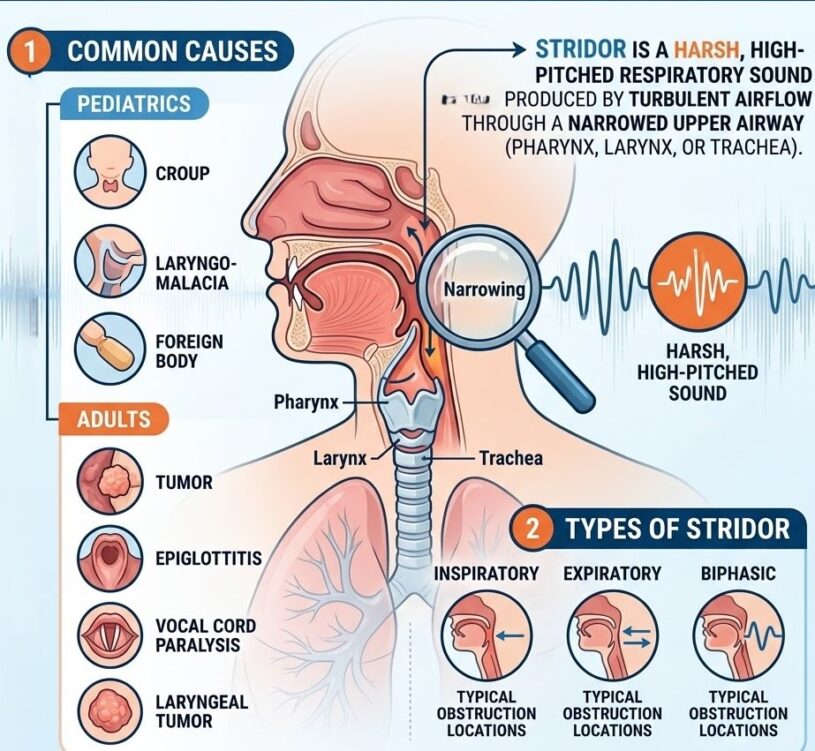
What is the Stridor?
Stridor is a harsh, high-pitched respiratory sound produced by turbulent airflow through a narrowed upper airway (pharynx, larynx, or trachea). It is a sign of significant airway obstruction, not a diagnosis.
Physics of Stridor:
Poiseuille's Law
Airflow resistance R is inversely proportional to the 4th power of the
radius: R = 1/r^4
This means a 50% reduction in radius increases resistance 16-fold.
This explains why the airway can compensate until ∼50% of lumen is lost, then deteriorates rapidly. Small edema, secretions or a foreign body causes a disproportionately large increase in work of breathing, especially in children where the baseline airway is small.
Bernoulli's Principle:
At a narrowed segment, velocity v increases, so lateral wall pressure P drops. This negative pressure sucks the compliant airway walls inward, worsening the narrowing dynamically. This creates a vicious cycle: narrowing -> faster flow -> lower pressure -> more collapse -> more stridor.
That is why an extrathoracic airway (above thoracic inlet) collapses on inspiration when intraluminal pressure is most negative, giving inspiratory stridor, while intrathoracic trachea collapses on expiration.
Stridor therefore indicates turbulent, high-velocity flow through a critically narrowed segment that is at risk of dynamic collapse.
Figure 1: Overview of Stridor
Pathophysiology
In a patient without a tracheostomy tube insitu, stridor means there is already significant narrowing of the larynx or trachea – IT IS NOT AN EARLY SIGN!.
General Rule on Stridor
Stridor is a sign of >50% obstruction of the airway lumen.
More detail perspective:
-
At rest, quiet breathing:
The adult larynx/trachea has to be narrowed by about 50% of its cross-sectional area before you hear stridor at rest. This is because the airway has a large reserve.
-
On exertion / crying / agitation in a child:
You may hear stridor earlier, at about 40% obstruction, because airflow is faster and becomes turbulent sooner.
-
Severe / biphasic stridor:
When narrowing reaches 70-75% or more, stridor becomes loud at rest, biphasic (both in and out), with chest recession and distress. This is critical obstruction.
-
Complete obstruction:
At about 80-90% occlusion, stridor may paradoxically become _quieter_ because very little air is moving - this is a pre-terminal sign, not improvement.
Why:
Airflow is normally laminar and silent. When the lumen narrows, flow becomes turbulent and produces the harsh high-pitched sound we call stridor. Extrathoracic obstruction (larynx, upper trachea) gives inspiratory stridor.
Intrathoracic tracheal obstruction gives expiratory stridor. Severe obstruction gives biphasic.
Clinical pearl:
-
Inspiratory stridor = larynx / supraglottis / glottis problem
-
Expiratory stridor = lower trachea / bronchi
-
Biphasic = subglottis / mid-trachea, or SEVERE OBSTRUCTION
NOTE:
For any patient in stridor , this is an emergency that requires ENT / anaesthesia help immediately, keep patient calm and upright, give oxygen, avoid agitating the patient, and do not attempt blind examination of the throat if epiglottitis is suspected in a child.
For a Patient Wearing a Tracheostomy Tube:
Noisy breathing (stridor, whistling, bubbling, or increased work of breathing) from the tube itself usually starts when there is significant narrowing.
General principles:
-
< 25-30% blocked:
Usually no noise at rest. Airflow remains laminar. May be noticed only on exertion or deep breathing.
-
~ 40-50% blocked:
Starts to become noisy, especially with dried secretions, crusting or blood clot acting as a partial valve. You may hear whistling, bubbling or high-pitched stridor.
-
> 50-60% blocked:
Consistently noisy, increased effort, difficulty passing suction catheter. This is clinically significant obstruction and needs urgent cleaning / inner cannula change.
-
> 70-75% blocked:
Severe distress, very loud stridor, reduced air entry, desaturation. Emergency.
Why noise happens:
The noise is not just about percentage. It is about turbulence. A small amount of thick, dried mucus on the wall can create turbulence and make a lot of noise even if the tube is only 30% blocked by volume. An inner cannula that is not cleaned regularly is the commonest cause.
Practical bedside check:
If you cannot easily pass a suction catheter to full length, or you hear persistent bubbling / whistling that does not clear after suction and inner cannula cleaning, treat as significant blockage.
In conclusion,
Stridor is a clinical red flag indicating at least 50% obstruction of the upper airway lumen and impending airway compromise. It signifies transition from laminar to turbulent flow governed by Poiseuille’s law, with dynamic worsening explained by Bernoulli’s principle.
It should never be ignored or sedated without airway assessment. Management principle is: keep patient calm and upright, give oxygen, identify level (inspiratory = laryngeal, expiratory = tracheobronchial, biphasic = subglottic/mid-tracheal or severe), and secure the airway with ENT and anaesthesia before complete obstruction occurs.
The quietening of previously loud stridor with increasing distress is a pre-terminal sign of exhaustion.
Share Post On:
Recent Posts
Categories
RELATED POSTS

Get in Touch
Read doctor-produced health and medical information written for you to make informed decisions about your health concerns.
Address
Adenta
info@grovehealth.net
Working Hours
Mon - Friday @ 8am - 5 pm