
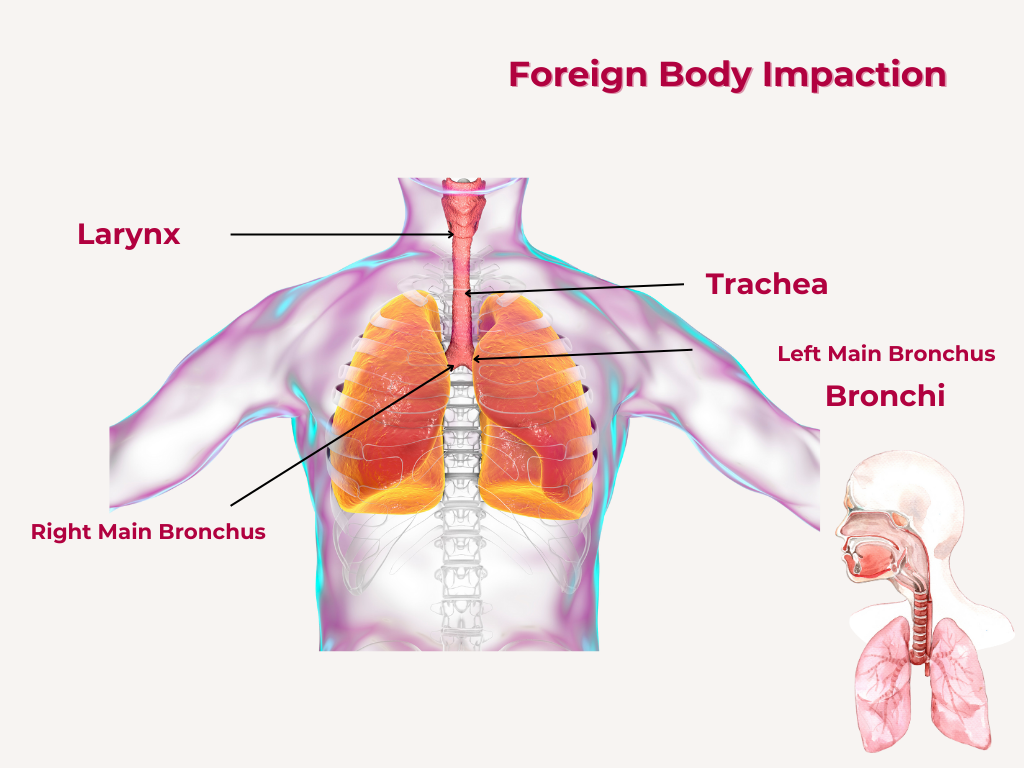
Foreign Body Impaction in the Larynx, Trachea, and Bronchi
Overview
Foreign body impaction in the larynx, trachea, and bronchi is a serious medical condition that requires prompt attention. It can cause significant morbidity and mortality if not managed properly.
Types of Foreign Bodies
Common types of foreign bodies that can become impacted in the larynx, trachea, and bronchi include:
1. Food particles: Peanuts, seeds, and other small objects.
2. Small objects: Coins, marbles, and other small toys.
3. Organic materials: Vegetable or animal matter.
Epidemiology
Foreign body aspiration is more common in:
-
1. Children:
Particularly those under 3 years old.
-
2. Adults with altered mental status:
Such as those with neurological disorders or substance abuse.
Pathophysiology
Foreign body impaction occurs when an object becomes lodged in the airway, potentially causing:
1. Obstruction: Partial or complete blockage of the airway.
2. Inflammation: Swelling and irritation of the airway tissues.
Investigations
Symptoms and signs
1. Coughing: Sudden onset of coughing or choking.
2. Difficulty breathing: Wheezing, stridor, or respiratory distress.
3. Cyanosis: Bluish discoloration of the skin due to inadequate oxygenation.
Investigations
-
1. Chest X-ray:
To identify radiopaque foreign bodies or signs of airway obstruction.
-
2. Computed Tomography (CT) scan:
To provide more detailed images of the airway and foreign body.
-
3. Bronchoscopy
To visualize the airway and foreign body directly.
Complications of Foreign Body Impaction
1. Respiratory failure: Due to airway obstruction or inflammation.
2. Pneumonia: Infection of the lung tissue.
3. Lung damage: Chronic inflammation or scarring.
Management
-
1. Bronchoscopy:
To remove the foreign body and restore airway patency.
-
2. Endotracheal intubation:
To secure the airway and ensure adequate oxygenation.
Special Situation
Managing a Long-Standing Impacted Foreign Body
-
1. Granulation tissue formation
May require additional treatment, such as antibiotics or anti-inflammatory medications.
-
2. Empyema thoracis
May require drainage of the pleural space.
-
3. Lung collapse
May require bronchoscopy or other interventions to re-expand the lung.
Preventive Measures
1. Supervise children: During meals and playtime.
2. Avoid giving small objects: To children.
3. Chew food thoroughly : To reduce the risk of aspiration.
Foreign body impaction in the larynx, trachea, and bronchi is a serious medical condition that requires prompt attention. Prompt recognition and management can help prevent complications and improve outcomes.
Share Post On:
Recent Posts
-
Nuggets of ORL-OTOLOGY
-
Nuggets of ORL-RHINOLOGY
-
Nuggets of Otorhinolaryngology-Basic sciences
-
Anatomy of the Muscles of the Soft Palate
-
Ethmoidal Arteries Ligation for Epistaxis
-
Submucous Cleft Palate (SMCP)
-
Approach to Ligation of the External Carotid Artery
-
Approach to Managing a 3-Year-Old Boy with a Foreign Body in the nasal cavity.
-
Approach to Managing a 3-Year-Old Boy with a Foreign Body impacted in the ear canal.
-
Endoscopic Sphenopalatine Artery Ligation (ESPAL) for Epistaxis
-
Surgical Management of Epistaxis
-
Technique of Incision and Drainage of Septal Hematoma/Septal Abscess
-
Upper Aerodigestive Tract Foreign Body Impaction
-
Incision and Drainage of Hematoma Auris
-
Rigid Bronchoscopy for Retrieval of Foreign Bodies in Children
-
Foreign Body Impaction in the Larynx, Trachea, and Bronchi
-
Leadership Position is a Tool, not a Trophy
-
Carcinoma of the Oropharynx
-
Peritonsillar Abscess
-
Ethics of Doctor-Patient Relationship
-
Doctor-Patient Relationship Case Scenarios
-
Asymmetrical Tonsils and Approach to Evaluation and Management
-
Nasal Polyposis
-
Rigid Oesophagoscopy and Complication
-
Anatomy of Oesophagus
-
Stridor, Snoring, Stertor And Wheezing: How They Compare
-
Temporomandibular Joint (TMJ)
-
Otoacoustic Emissions
-
Tympanometry
-
Functional Endoscopic Sinus Surgery (FESS)
Categories
RELATED POSTS
Get in Touch
Read doctor-produced health and medical information written for you to make informed decisions about your health concerns.