
All You Need To Know About Elongated Uvula
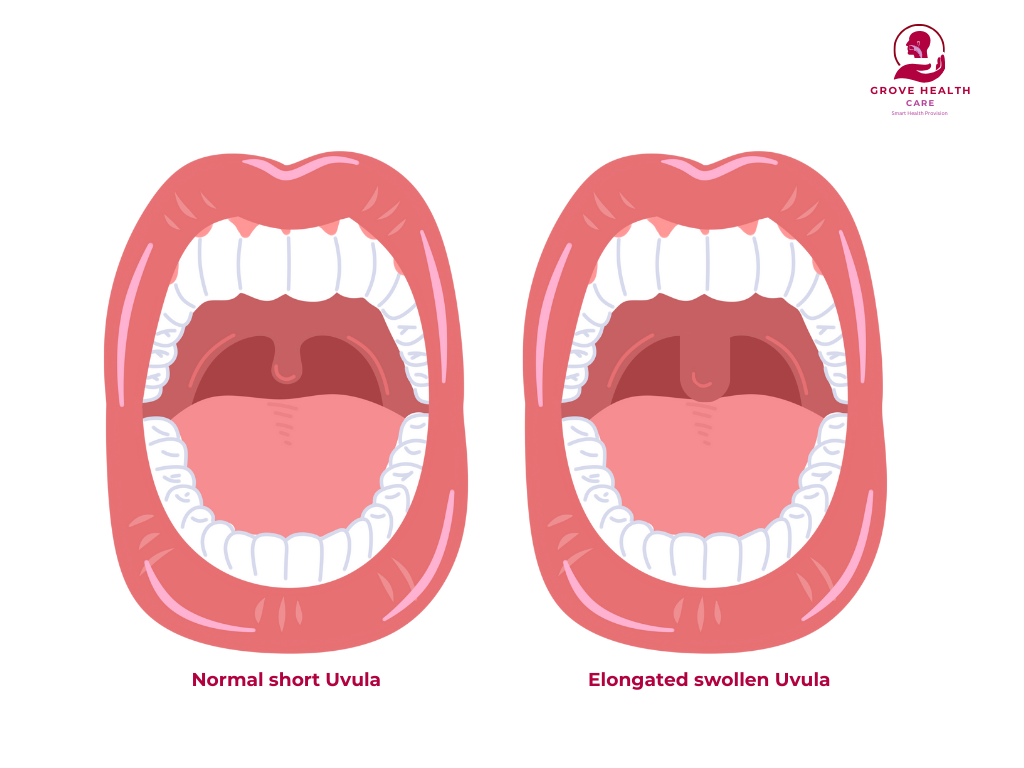
Elongated uvula
An elongated uvula is a condition where the structure located at the back of the throat, is longer than usual.
Here's what you need to know:
Causes
- Genetics: An elongated uvula can be inherited from one’s parents.
- Aging: The uvula can lengthen with age due to the relaxation of the surrounding tissues.
- Infections: Certain infections, such as tonsillitis or pharyngitis, can cause the uvula to become inflamed and elongated.
- Allergies: Seasonal or perennial allergies can cause postnasal drip, leading to uvula elongation.
- Laryngopharyngeal Reflux (LPR): Reflux of acid and stomach contents into the throat can cause inflammation and elongation of the uvula.
Symptoms
- Snoring: An elongated uvula can cause snoring due to the obstruction of airflow through the throat.
- Sleep Apnea: The elongated uvula can also contribute to sleep apnea, a condition characterized by pauses in breathing during sleep.
- Difficulty Swallowing: In some cases, an elongated uvula can cause difficulty swallowing (dysphagia) due to the obstruction of the throat.
- Sore Throat: An elongated uvula can cause a sore throat, especially if it is inflamed or irritated.
- Difficulty with speech: Elongated uvula can cause difficulty with speech, such as breaks in speech flow or excessive salivation during speech.
- Miscellaneous: Tickling sensation in the throat, Irritative cough, excessive salivation especially during speech or FOSIT( Feeling Of Something In the Throat).
Diagnosis
-
Physical examination
A healthcare professional can diagnose an elongated uvula through a physical examination of the throat.
-
Endoscopy
A flexible tube with a camera and light (endoscope) may be used to visualize the uvula and surrounding tissues.
-
Imaging studies
In some cases, imaging studies such as X-rays or CT scans may be ordered to rule out other conditions.
Treatment
-
Watchful waiting
If the elongated uvula is not causing any symptoms, a healthcare professional may recommend watchful waiting.
-
Uvulectomy
A surgical procedure to remove part of the uvula to improve function and discomfort.
-
Uvulopalatopharyngoplasty (UPPP)
A surgical procedure that removes the elongated uvula and surrounding tissues to improve airflow and reduce snoring.
-
Radiofrequency ablation
A minimally invasive procedure that uses radiofrequency energy to shrink the elongated uvula.
-
Laser treatment
A laser can be used to remove the elongated uvula and surrounding tissues.
Complications
-
Respiratory problems
An elongated uvula can cause respiratory problems, such as sleep apnea and snoring.
-
Difficulty swallowing
In some cases, an elongated uvula can cause difficulty swallowing, which can lead to malnutrition and weight loss.
-
Speech problems
An elongated uvula can cause speech problems, such as a nasal tone or difficulty articulating certain sounds.
Prevention
- Maintain a healthy weight: Excess weight can cause the uvula to become elongated.
- Avoid smoking: Smoking can cause inflammation and irritation in the throat, leading to uvula. elongation.
- Manage allergies: Seasonal or perennial allergies can cause postnasal drip, leading to uvula elongation.
Share Post On:
Recent Posts
-
Stridor Demystified
-
Management of Septal Deviation
-
Anatomy of Nasal Septum / Septal Pathology
-
Comprehensive Overview of Infectious Mononucleosis
-
Types of pulse oximeters
-
Laser In Modern Otorhinolaryngology (Orl) Practice
-
Comprehensive Overview of Choanal Atresia
-
Comprehensive Overview of Adenoids & Adenoid Facies
-
Synoptic Overview Of Glue-Ear = Serous Otitis Media / Otitis Media With Effusion (OME)
-
Plummer-Vinson Syndrome / Paterson-Brown-Kelly Syndrome
-
All you need to know about Continuous Positive Airway Pressure (CPAP)
-
Nuggets of ORL-Head & Neck Surgery
-
Nuggets of ORL- Operative Surgery
-
Overview of AI Tools In Modern ORL Practice
-
Nuggets of ORL-LARYNGOLOGY
-
All You Need To Know About PET Scan
-
Nuggets of ORL-PAEDIATRICS
-
Nuggets of ORL-OTOLOGY
-
Nuggets of ORL-RHINOLOGY
-
Nuggets of Otorhinolaryngology-Basic sciences
-
Anatomy of the Muscles of the Soft Palate
-
Ethmoidal Arteries Ligation for Epistaxis
-
Submucous Cleft Palate (SMCP)
-
Approach to Ligation of the External Carotid Artery
-
Approach to Managing a 3-Year-Old Boy with a Foreign Body in the nasal cavity.
-
Approach to Managing a 3-Year-Old Boy with a Foreign Body impacted in the ear canal.
-
Endoscopic Sphenopalatine Artery Ligation (ESPAL) for Epistaxis
-
Surgical Management of Epistaxis
-
Technique of Incision and Drainage of Septal Hematoma/Septal Abscess
-
Upper Aerodigestive Tract Foreign Body Impaction
Categories
Get in Touch
Read doctor-produced health and medical information written for you to make informed decisions about your health concerns.