
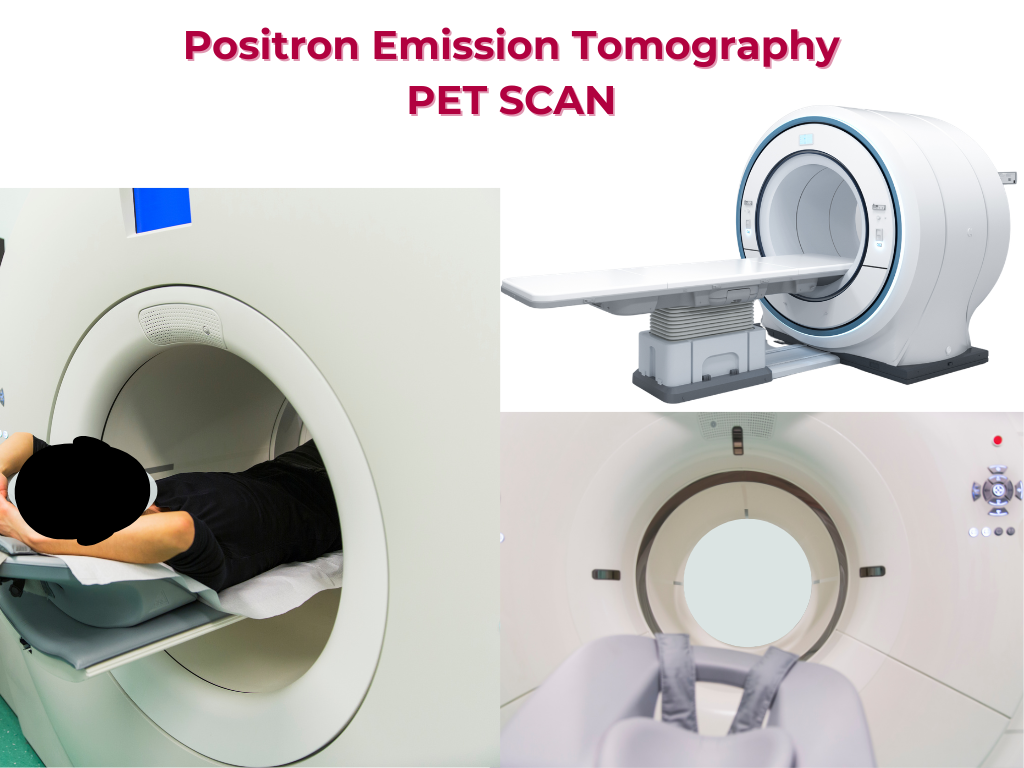
Overview
PET Scan is a nuclear medicine imaging technique used to assess metabolic activity in the body.
Introduction / Historical Perspective
Positron Emission Tomography (PET) Scan is a medical imaging technique that uses radioactive tracers to visualize metabolic processes in the body. Developed in the 1970s, PET scans have become crucial in diagnosing and managing various diseases, especially cancer.
What is a PET scan?
A PET scan is a type of imaging test that uses a radioactive tracer (usually FDG – Fluorodeoxyglucose) to detect metabolic changes in the body, highlighting areas with high glucose uptake, like cancer cells.
Mechanism of PET Scan
- 1. Injection of FDG tracer
- 2. Uptake by cells (higher in cancer cells)
- 3. Emission of positrons, detected by scanner
- 4. Image creation showing metabolic activity
Indications for PET Scan
- Cancer diagnosis and staging (e.g., lung, breast, lymphoma)
- Monitoring treatment response
- Detecting recurrence
- Neurological disorders (e.g., Alzheimer's)
Contraindications for PET Scan
- Pregnancy/breastfeeding
- Uncontrolled diabetes (affects image quality)
- Allergy to tracer components
Interpretation of PET Scan Images
SUV (Standardized Uptake Value):
Measures the tracer uptake.
- High SUV often indicates malignancy
- Correlate with clinical history and other imaging
Correlations Between CT Scan, MRI Scan, and PET Scan
| Modality | Use Case |
|---|---|
|
PET Scan |
Metabolic activity |
|
CT Scan |
Structural info (anatomy) |
|
MRI Scan |
Soft tissue detail |
Test Details
Sensitivity
-
High for detecting metabolic changes (e.g., cancer)
~85-90% for many cancers
Specificity
-
Good (~80-90%) but depends on context and tracer used
False Positivity
-
Inflammation, infection, brown fat uptake
False Negativity
-
Small lesions, low metabolic activity tumors
Negative Predictive Value
-
High if PET scan is negative (often rules out active disease)
Positive Predictive Value
-
Depends on pre-test probability and SUV values
Best Time for Postoperative PET Scan
-
Typically 2-3 months after surgery to avoid post-op inflammation
Best Time for PET Scan After Radiotherapy
-
3-4 months post-radiotherapy to minimize false positives from inflammation
PET scans are valuable for assessing metabolic activity, aiding diagnosis, staging, and treatment monitoring, especially in oncology. Interpretation requires correlation with clinical context and other imaging.
Share Post On:
Recent Posts
-
Nuggets of ORL- Operative Surgery
-
Overview of AI Tools In Modern ORL Practice
-
Nuggets of ORL-LARYNGOLOGY
-
All You Need To Know About PET Scan
-
Nuggets of ORL-PAEDIATRICS
-
Nuggets of ORL-OTOLOGY
-
Nuggets of ORL-RHINOLOGY
-
Nuggets of Otorhinolaryngology-Basic sciences
-
Anatomy of the Muscles of the Soft Palate
-
Ethmoidal Arteries Ligation for Epistaxis
-
Submucous Cleft Palate (SMCP)
-
Approach to Ligation of the External Carotid Artery
-
Approach to Managing a 3-Year-Old Boy with a Foreign Body in the nasal cavity.
-
Approach to Managing a 3-Year-Old Boy with a Foreign Body impacted in the ear canal.
-
Endoscopic Sphenopalatine Artery Ligation (ESPAL) for Epistaxis
-
Surgical Management of Epistaxis
-
Technique of Incision and Drainage of Septal Hematoma/Septal Abscess
-
Upper Aerodigestive Tract Foreign Body Impaction
-
Incision and Drainage of Hematoma Auris
-
Rigid Bronchoscopy for Retrieval of Foreign Bodies in Children
-
Foreign Body Impaction in the Larynx, Trachea, and Bronchi
-
Leadership Position is a Tool, not a Trophy
-
Carcinoma of the Oropharynx
-
Peritonsillar Abscess
-
Ethics of Doctor-Patient Relationship
-
Doctor-Patient Relationship Case Scenarios
-
Asymmetrical Tonsils and Approach to Evaluation and Management
-
Nasal Polyposis
-
Rigid Oesophagoscopy and Complication
-
Anatomy of Oesophagus
-
Stridor, Snoring, Stertor And Wheezing: How They Compare
-
Temporomandibular Joint (TMJ)
-
Otoacoustic Emissions
-
Tympanometry
-
Functional Endoscopic Sinus Surgery (FESS)
-
Tracheostomy
-
Clinical Voice Test (CVT) for Hearing Loss
-
Acute Epiglottitis And Approach To Management
-
Synoptic Overview Of Nasopharyngeal Carcinoma
-
Prioritizing Support For People With Disabilities Over Unhealthy Competitions That Marginalise The Downtrodden
Categories
Get in Touch
Read doctor-produced health and medical information written for you to make informed decisions about your health concerns.